Vodun Days 2027, Ouidah, 2–9 January. The heart of the ceremonies: 7, 8 and 9 January. Our tour from USD 2,905, hotel and all meals included, 9 seats left. See the tour →

Travelling for the festival? Nine days in Benin, 2–10 January 2027, the whole festival week, from USD 2,905 per person with hotel and all meals, ten travellers at most, nothing to pay before we meet — see what it costs.

VODUN DAYS — OUIDAH, BENIN — 2–9 JANUARY 2027
Next edition — January 2027

Voodoo Festival Benin 2027Vodun Days at Ouidah, 2–9 January: dates, programme, how to attend

Walk the routes.Meet the religion where it lives.
9 days in Benin
2–10 January 2027, from Cotonou
From USD 2,905
per person, hotel and all meals included. The heart of the ceremonies: 7, 8 and 9 January
Ten travellers at most
or you alone, with your own guide
Nothing to pay before we meet
no deposit; settled the day you arrive

VIP seat at the great ceremony · Sahouè-Doutou · every lunch and dinner · pirogues and transfers. Hotels booked for you at cost, or left to you. See the full price table ↓

Write on WhatsAppSend us your dates

Updated October 2026

Voodoo Festival Benin 2027: the dates and the essentials

Dates
Saturday 2 to Saturday 9 January 2027, eight days. The last three days, 7 to 9 January, are the heart of the ceremonies. Thursday 7 and Friday 8 January are public holidays.
Where
Ouidah, forty-five minutes west of Cotonou, on five sites: Place Maro, the esplanade of the French Fort, Place Ninsouxwé, the Sacred Forest of Kpassè and the beach at the Door of No Return. The five sites
Tickets
There are none. The squares, the arena and the beach are free and open to everyone. The Sacred Forest and the Temple of Pythons charge 2,000 to 3,000 CFA at the gate.
Programme
Set by the Ministry of Tourism, Culture and Arts with Benin Tours and published in December; we post it here the day it is out. How the week is structured
Getting there
Fly to Cotonou (COO). Benin e-visa online at evisa.bj, usually within days; yellow fever certificate checked at the airport. January logistics
Where to sleep
Ouidah’s few hotels are full months ahead and noisy during the festival; sleep in Cotonou and drive in each morning.
With us
Nine days in Benin, 2 to 10 January 2027, the whole festival week with a VIP seat at the beach ceremony, hotel and all meals, ten travellers at most, nothing to pay before we meet, from USD 2,905. The Vodun Days tour 2027 · Questions travellers ask

Vodun Days, the Ouidah voodoo festival as most visitors call it, is the official festival of the Beninese state in recognition of Vodun. If you are new to the religion, start with what Vodun actually is. It takes place every year at Ouidah over eight days — 2 to 9 January in 2027 — and it is one of the largest religious-civic events of the West African coast. Practitioners, descendants of the diaspora, scholars, journalists, and the Beninese institutional apparatus converge for eight days that braid the Vodun ritual calendar with public commemoration, political symbolism, and contemporary cultural patrimony.

Heritage and Routes takes you through Vodun Days as it should be seen: with someone who knows which square is playing at which hour, who is known to the priests, and who stands beside you when the masks pass. One traveller or ten, never more, and someone who knows the squares from the first morning to the airport. The eight days can also open a longer route: see our journeys in Benin, from the port of Ouidah to the royal palaces of Abomey. The journeys we run around the coming edition, and what they cost, are set out below.

Your guide is Fèmi Kochoni, founder of Heritage and Routes, a graduate in African and Diaspora Studies of the Université d'Abomey-Calavi, and for years Tour Director for Odysseys Unlimited and Grand Circle across Ghana, Togo and Benin. He lives in Cotonou; he does not visit the coast, he belongs to it.

— Our editorial line

Benin's voodoo festival is not a carnival. It is a festival of the state, of the religion, and of the diaspora — in that order.

We accompany the festival within the framework that Benin Tours, the Ministry of Tourism, Culture and Arts, and the Vodun community of Ouidah have built since 1996. Our programmes coordinate ceremonial access with the practitioners, never around them.

— What is Vodun Days

A state-recognised festival, since 1996

Vodun Days was instituted by the Beninese state in 1996, the year Benin granted Vodun legal recognition as a religion and made 10 January a public holiday. The recognition was both political and cultural: it formalised an institutional relationship between the state and Benin Tours, and it positioned Vodun as a cultural patrimony available for civic celebration alongside its religious life.

The festival has grown across three decades. What began in 1996 as a single public holiday on 10 January became, in recent editions, three days around that date, and in 2027 it is a full week ending on 9 January: 2 to 9 January — and it drew some 740,000 participants in 2026, up from 435,000 the year before — Beninese citizens, diaspora pilgrims arriving from Brazil, Haiti, Cuba and the African diaspora communities in the United States and Europe, journalists, photographers, academics, government officials, and the corps of foreign ambassadors based in Cotonou. The town of Ouidah transforms entirely for the duration of the festival. Hotels book a year in advance.

What it is not

Vodun Days is not a folkloric spectacle. The ceremonies are real ritual moments led by initiated practitioners under Benin Tours coordination. Photography is permitted in some moments and restricted in others — the practitioners decide. The festival is a window onto a living religion, not a performance for visitors.

— The eight days

How the eight days are structured

Vodun Days 2027 runs for eight days, from 2 to 9 January, in Ouidah. The 1996 decree fixed 10 January as a single public holiday for the traditional religions. In recent editions the festival ran for three days around that date; in 2027 it becomes a full week, from 2 to 9 January, ending on the 9th rather than the 10th. Eight days is the format of the 2027 edition, and the only figure that describes it.

The week has a shape, and it matters for your dates. The opening days belong to the civic register and to the ceremonies each lineage holds on its own square. The festival is at its strongest at the end: Friday 8 January on the squares, and Saturday 9, when the closing takes place at the Ouidah Arena in the afternoon and the great ecumenical ceremony gathers the lineages on the beach at night. The public holiday of the traditional religions now falls on the second Friday of January, Friday 8 January in 2027, with Thursday 7 also a holiday. If you can only give it a few days, give it the 7th, the 8th and the 9th: they are the heart of the ceremonies.

The detailed programme — which ceremony falls on which day, at which site — is set each year by the Ministry of Tourism, Culture and Arts in coordination with Benin Tours and the lineages, and it is released close to the festival. We publish it here as soon as it is available. What follows is the ritual geography that holds from year to year, not a schedule.

— Civic.
Ouidah, Place des Vodun

Inauguration, conferences, panels

The civic register opens the festival: the official inauguration at the Place des Vodun in Ouidah, academic conferences hosted by the Ministry of Tourism, Culture and Arts, and panel discussions with Benin Tours representatives, scholars from the Université d’Abomey-Calavi, and visiting researchers.

This is where we set the editorial frame — briefings with our academic partners, and the first conversations with the practitioners who accompany us through the festival.

— Ceremonial.
Ouidah, the ritual sites

The Great Vodun Ceremony

The central ceremonial register unfolds across multiple sites in Ouidah, with different Vodun lineages presenting at different locations. Place Maro hosts the Egungun masqueraders. The Esplanade of the French Fort hosts the Zangbéto night guardians. Place Ninsouxwé hosts the Zomadonou. The Sacred Forest of Kpassè hosts the Hounvè inner ceremonies.

Our programmes coordinate access for the public moments and, where the priesthoods permit, for restricted moments. Photography policy is briefed in advance and re-confirmed in real time at each site.

— Closing.
Ouidah, the Atlantic shore

The Door of No Return

The closing register moves toward the Atlantic: ceremonies at the Mami-Beach Temple, the formal closing at the Ouidah Arena on Saturday 9 January, then the final movement to the Door of No Return beach, where libations, prayer and the closing rites face the ocean.

For diaspora pilgrims, the beach at the Door of No Return is often the most charged moment of the whole festival — the geography of return and the geography of departure, on the same sand.

Updated September 2026. The 2026 edition drew some 740,000 participants over the week, seventy per cent more than 2025, inaugurated the new Ouidah Arena on the beach, and put Kassav', Sagbohan Danialou, Toofan and the Balé Folclórico da Bahia on the seafront stage. The organisers' press pack for 2026 is public; the 2027 programme is published in December on vodundays.bj, and we relay it as soon as it is out.
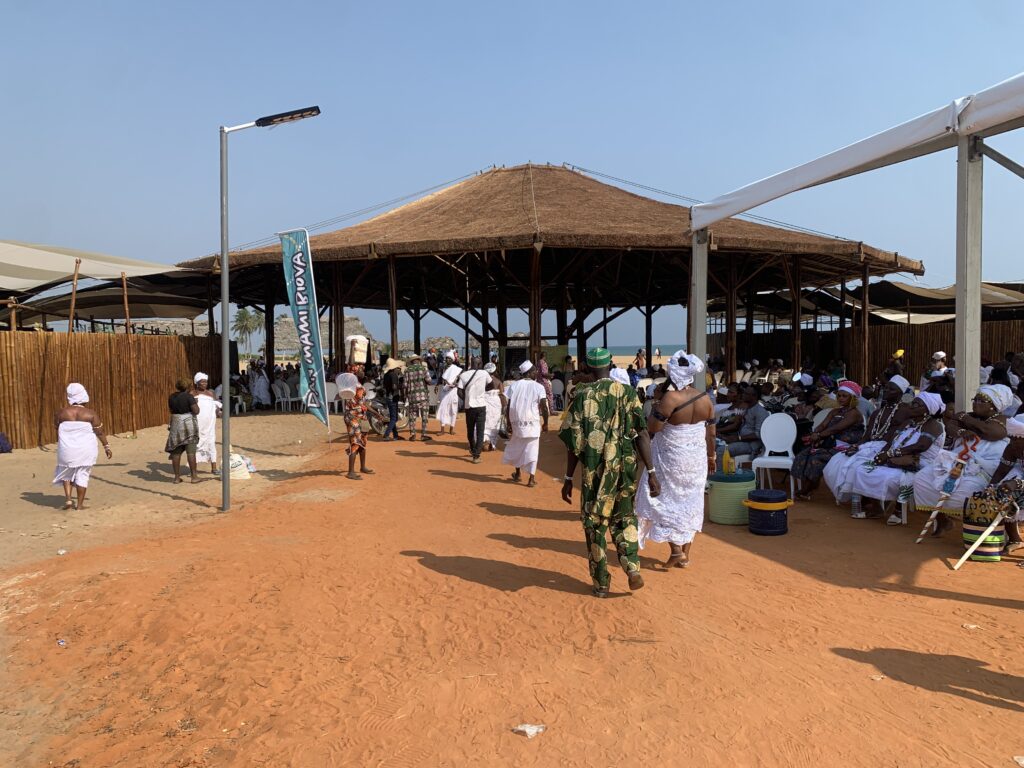
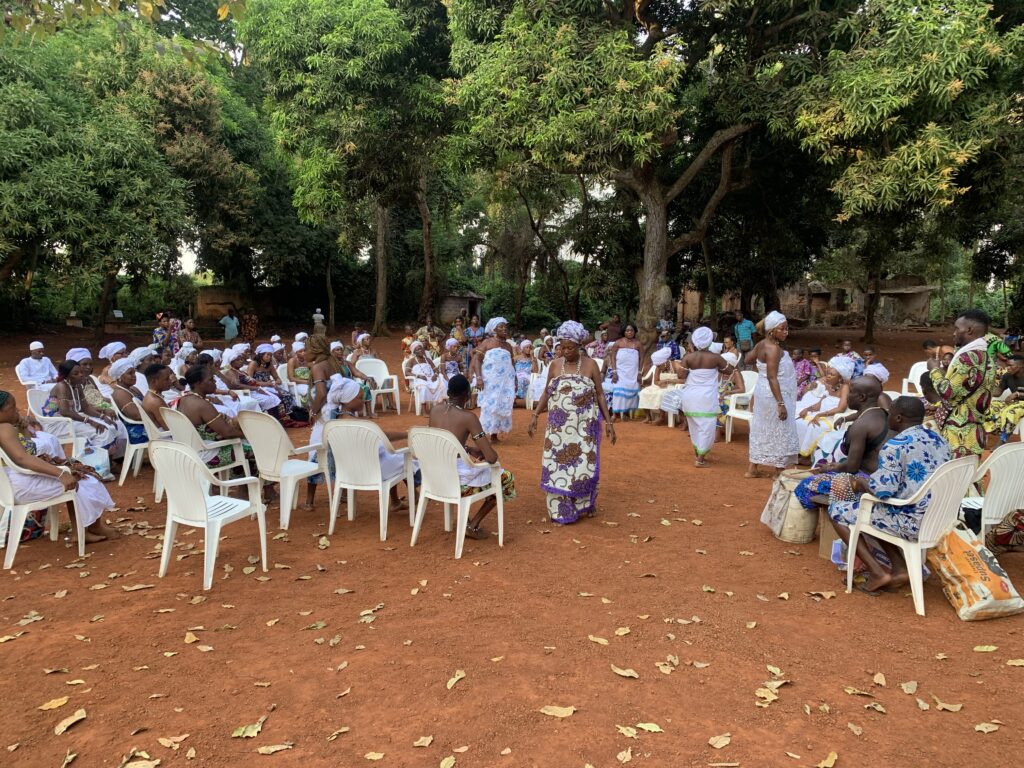
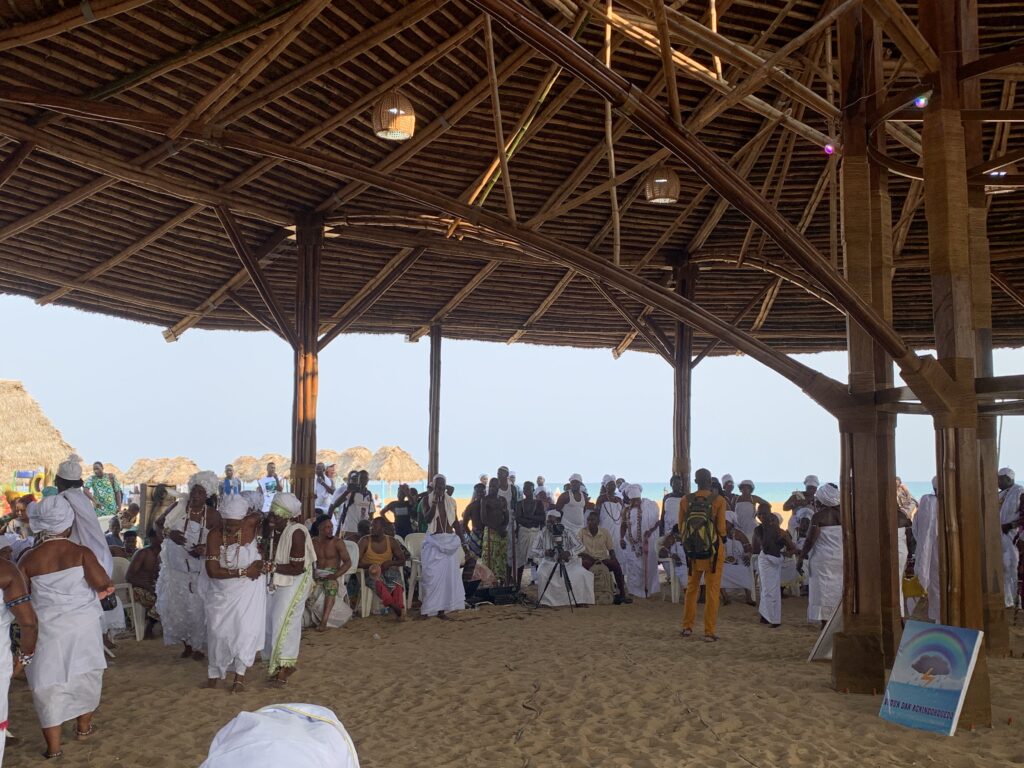
Adepts in white on one of the ceremonial squares of Ouidah, Vodun Days 2026
The squares by day.
Assembly of Vodun adepts dressed in white during a ceremony, Benin, January 2026
White is the colour of the festival.
Vodun ceremony under the thatched shelter on the beach of Ouidah, Vodun Days 2026
The beach, the night of the great ceremony.

Photographs Heritage and Routes, Ouidah, January 2026.

Geography of the festival

The five sites where Vodun Days unfolds

Vodun Days does not happen in a stadium. The festival distributes itself across the city of Ouidah — across a square, an esplanade, a sacred forest, a temple of the waters, and finally the beach. Each site belongs to a specific lineage and a specific ceremony. The order matters. The geography is the liturgy.

Site 1 — Egungun

Place Maro

Place Maro is the square where the Egungun appear — masked ancestors of Yoruba origin, intermediaries between the living and the dead. The dancers do not perform. They manifest. The costumes — heavy stacked fabrics that hide every centimetre of human body — turn the bearer into a vehicle for an ancestor. Touching an Egungun is taboo. Crossing their path during the dance is dangerous. The square is marked, guarded, organised by initiates of the cult.

What you watch here is a transmission across the ocean. The Egungun cult travelled with enslaved Yoruba to Bahia and Cuba, where it survives inside Candomblé and Lucumí. Ouidah is the West African node of that triangle. Place Maro is where the diaspora can find the ancestor again.

Site 2 — Zangbéto

Esplanade of the French Fort

The Zangbéto — "night guardians" — emerge in front of the French Fort, the colonial bastion that once organised the embarkation of captives. The choice of site is deliberate. The Zangbéto are the traditional night police of Goun and Pédah societies, conical haystack figures that spin, dance, and appear to move autonomously. They open passages between the visible world and the invisible.

To stage them on the esplanade of a fort built to extract bodies is, every January, an act of reoccupation. The stones that watched the deportation now watch the dance.

Site 3 — Zomadonou

Place Ninsouxwé

Place Ninsouxwé belongs to Zomadonou — the cult of "extraordinary children", born with a difference (twins, disabilities, prophetic dreams) and considered marked by divinity. This is the most intimate register of the festival. Families come with offerings for children lost. Lineages reaffirm their pacts. The drumming is slower here, more interior.

A discreet etiquette governs this site. Heritage and Routes negotiates a small viewing perimeter with the head priest in advance, never on the day.

Site 4 — Hounvè

Sacred Forest of Kpassè

The Kpassè forest is the founding site of Ouidah. The place where King Kpassè, the founder, is said to have transformed himself into an iroko tree to escape his enemies and remain alive in the wood. The Hounvè ceremony, on Day 2 of the festival, returns the city to that originary moment. Drums under the canopy, libations at the foot of the iroko, the dancers slipping between the trees.

The forest is not a stage. It is a temple with no walls. We brief our travellers on what to wear, where to step, what not to photograph. Most of our hosts here are themselves descendants of the lineages that maintain the forest.

Site 5 — Mami Wata · Door of No Return

Mami-Beach Temple and the Door of No Return

The festival closes at the beach. The Mami-Beach temple is dedicated to Mami Wata, the divinity of the waters, where the freshwater of the lagoon meets the saltwater of the Atlantic. From there, the procession walks the final stretch of the Slave Route to the Door of No Return — the arch that marks the point where, between roughly 1671 and 1865, perhaps a million captives walked into the sea.

There is no spectacle at this site. The drums quiet. The procession stops. People take sand into their hands and let it fall. Diaspora travellers often choose to walk this last kilometre alone. We do not interrupt that.

Travelling with us for Vodun Days 2027

Nine days in Benin, 2 to 10 January 2027, built around the heart of the festival, 7 to 9 January, hotel and meals included, from USD 2,905 per person

Ten travellers at most, a seat in the reserved enclosure for the great beach ceremony, nothing to pay before we meet in Cotonou. The full day-by-day programme, what is included and the price table are on the tour page.

▾ How we accompany you, January logistics and the price table (read on this page)

Operator approach

How Heritage and Routes accompanies you through Vodun Days

A festival of this density does not improvise. We work with the priesthoods of each site, twelve weeks before the first travellers land. The pre-clearance is not a feature. It is the precondition.

01

Pre-clearance and access

Benin Tours is the institutional body that organises Vodun Days alongside the Ministry of Tourism. We submit, well before each edition, the profile of every group: number of travellers, places of origin, any specific lineage interest. Without that prior notice, the access we provide does not exist.

02

Pact with the priesthoods

Each site has a head priest. We meet them in October, sometimes November, in person. The offering, the announcement, the questions the group will be allowed to ask — all of it is agreed in advance. Improvisation is not respect. It is intrusion.

03

Group size capped at ten

Ten travellers, never more. Not for logistics. Because beyond ten, the relationship to the ceremony changes — the group becomes a public, and the host becomes a performer. We refuse that shift. A traveller who comes alone may be joined by others on the festival days; the price falls for everyone when that happens, and we say so before anyone leaves home.

04

Daily debriefs

At the end of every day, we sit down — for an hour, sometimes longer. What did you see. What did you not understand. What pulled. The festival asks more of you than it gives at first sight. The debrief is part of the route.

Practical

Logistics for January in Ouidah

Climate

January falls in the dry season. The harmattan blows down from the Sahel — dust in the air, cooler nights, mid-eighties Fahrenheit in the day. Light layers, closed shoes for the forest, modest dress for the temple sites.

Group size

Ten travellers maximum. Larger parties are split into two groups, each with its own guide and vehicle. We do not exceed ten under any condition.

Visa and vaccines

Benin issues e-visas to most passports. Yellow fever vaccination is mandatory. We recommend hepatitis A, typhoid, and antimalarial prophylaxis. We share a per-passport briefing four months out.

Lodging

All nights are in Cotonou. Ouidah is forty-five minutes away, and returning each evening gives you a better hotel and a quieter night than the town offers during the festival; Ouidah's few rooms are taken months ahead. We hold rooms in a quiet three-star ten minutes from the airport; they are in our price, at cost, with breakfast. January is the peak season on this coast: rooms and VIP seats are held for you until 15 November; after that, on availability.

Languages

All briefings in English or French. On site, our hosts translate between Fon, Yoruba, Goun, and the working language of the group.

Photography

Each site has its own rule. Some allow photography from a distance, some prohibit it entirely, some require an offering before the camera is lifted. We brief on the morning of each day.

Activity level

The two festival days are rated 4 out of 5: six to eight kilometres a day on foot, from square to square and convent to convent, on sand and packed earth, in heat, with a late night on the 9th and stairs at the Portuguese fort. The other days are 2 out of 5.

Investment

What it costs, and why it falls as the group grows

Our reference journey around Vodun Days 2027 is nine days in Benin, 2 to 10 January, the whole festival week, based in Cotonou: Ouidah on the opening days, Ganvié, Grand-Popo and the Mono, Porto-Novo and the Dark River at Adjarra; then the three days at the heart of the festival: Ouidah on the 7th, the squares and convents on the 8th, Sahouè-Doutou by day on the 9th, then the closing at the arena and the great ecumenical ceremony on the beach with VIP seating; departure on the 10th. It is from USD 2,905 per person, hotel and meals included; your exact price is confirmed in your written proposal. That includes eight nights in a quiet three-star in Cotonou with breakfast, the vehicle and driver, the guiding throughout, every entrance and every contribution to the communities and the priesthoods, the VIP seat, the pirogues, lunch and dinner from the evening of the 2nd to the 9th in restaurants we have chosen (a picnic on the Sahouè day, where there is nowhere to sit down to eat), bottled water in the vehicle, the airport transfers, and all tips except your guide's. Only flights, visas, drinks and travel insurance are not included. The hotel is added at cost: we take no margin on it.

Per person, hotel in a shared double room and all meals included, VAT included: from USD 2,905. Your exact price is confirmed in your written proposal. The double room is shared with the person you travel with; alone, a single room adds USD 465. Ten travellers at most: 9 seats left. The tour itself, day by day, with what is included, is on the Vodun Days tour page.

Nothing is paid before we meet. We ask no deposit: the whole amount is settled on the day you arrive, once you have seen that we are there, in cash, or by a transfer timed to arrive that day. We commit the VIP seats, the rooms and the access at Doutou on our own account beforehand; in return we ask only that you tell us at once if your plans change.

Two practical dates. January is the peak season on this coast and the hotels fill: rooms and VIP seats are held for you until 15 November; after that, on availability.

Tell us your dates, we answer within 48 hours

One message is enough: your dates, how many of you, Benin alone or with Togo and Ghana. You get a written proposal, day by day, with the full price; no deposit until we have met in Cotonou.

Write on WhatsAppSend us your dates

Questions you have asked us

FAQ — Vodun Days, the things travellers want to know first

Is Vodun Days safe for outsiders?

Yes, when you come through accompaniment. The Beninese state organises the festival precisely so that the public — Beninese and foreign — can witness ceremonies that the rest of the year take place behind closed doors. The risks are not security risks. They are etiquette risks. Approaching an Egungun, photographing without permission, stepping onto the wrong patch of sacred ground. These are the failures we exist to prevent. Two practical points: pickpockets work the arena crowd as at any festival, so carry little; and the police keep everyone out of the sea at night, because sodabi and swimming do not mix.

Can I attend without joining a group?

Yes. The squares, the esplanade and the arena are public, and the state organises the festival so that anyone may watch. What you cannot do alone is know which square is playing at which hour, stand where the drums can be heard, enter the closer perimeters that require a guide known to the head priests, or be received in a convent. Doutou, in the Sahouè country, is not open to a visitor arriving on their own. That is the difference accompaniment makes.

When are the exact dates?

Vodun Days 2027 runs for eight days, from Saturday 2 to Saturday 9 January 2027, at Ouidah, with parallel events in adjacent cities (Abomey, Allada, Grand-Popo). The 1996 decree instituted a single public holiday on 10 January; in recent editions the festival ran for three days around that date, and in 2027 it becomes a full week ending on 9 January. Its last three days, 7 to 9 January, are the heart of the ceremonies, ending with the closing at the Ouidah Arena and the great ceremony on the beach. Thursday 7 and Friday 8 January are public holidays. The detailed programme is published by the Ministry and Benin Tours in December, and we relay it here as soon as it is available; the state has moved dates before, and we adapt on the day.

How crowded is it, really?

Very. The 2026 edition counted some 740,000 participants over the week; on the 8th and the 9th the squares are shoulder to shoulder and the beach at night is a stadium crowd. That is the festival, not a defect of it. What we do is place you: on the squares, where the crowd is the point, we stand with you at the spot where the drums can be heard and the masks pass; for the ceremony on the beach, where the crowd is the risk, we include a seat in the reserved enclosure.

How do we get around Ouidah on festival days, and how bad is the traffic?

On foot, mostly. On the strong days the centre is closed to vehicles from mid-morning; we park at the edge of town and walk from square to square, six to eight kilometres over the day, with places to sit and drink water at each site. The road from Cotonou takes forty-five minutes in the morning; coming back after the ceremonies it can take twice that, and the town empties in one wave around midnight. We leave when the last Vodun has danced, not before, and we know the roads out. Bring flat shoes you can walk in and sand out of.

Is the VIP pass worth it?

Some travellers say the roped enclosure separates you from the energy, and by day they are right: on the squares we do not use it. At night on the beach, for the great ceremony, it is the difference between seeing the lineages enter and seeing the back of a crowd of thousands. We include one seat per traveller and one for your guide beside you, for that ceremony only.

Where do we sleep, and why not in Ouidah?

In Cotonou, every night. Ouidah's few hotels are full months ahead, noisy and overpriced during the festival; forty-five minutes on the coast road gives you a proper hotel and a quiet night. We hold rooms in a quiet three-star ten minutes from the airport; they are included in our price, at cost, with breakfast. For those who want to be inside the festival, the organisers run a camping ground by the arena (about 7,000 CFA a night with your own tent, 20,000 with a rented one); we do not recommend it after the age of thirty, and we say so with affection.

What does it cost on the ground?

The squares and the beach are free. The sacred forest and the Temple of Pythons charge 2,000 to 3,000 CFA; a plate of grilled fish or akassa from a street stall is 1,000 to 2,000; a beer 1,000; a local guide for the day 20,000 to 30,000. All of it is inside our price, contributions to the priesthoods included.

What should I wear?

White is customary among practitioners on the 10th, and welcome on any day; avoid all black. Modest dress at the temples, light layers for the harmattan, flat closed shoes for sand and forest, a layer for the beach at night.

Can I take photographs?

On the squares and at the arena, yes, and nobody minds. Ask before photographing a person, always. Some sites forbid it; some require an offering first; a possession is never photographed unless we tell you it is permitted. We brief you each morning, site by site. See also our field note on arriving in Ouidah for Vodun Days.

Can I come alone, and will I be put in a group?

Yes, and perhaps. A traveller alone may be joined on the festival days by others who chose the same dates, never more than ten of us in all; and we tell you beforehand who is coming. If you would rather keep the days to yourself, say so and we price it in your written proposal.

Can I combine Benin with Togo and Ghana?

Yes, in three ways, and all three include the heart of the festival, 7 to 9 January. The Vodun week, 2 to 10 January, in Benin, from USD 2,905. From Lomé, 5 to 10 January: Lomé and the Akodessewa fetish market on the 5th, Lake Togo by pirogue to Togoville on the 6th, then into Benin on the 7th to join the group in Ouidah; priced on request. Benin, Togo and Ghana, 7 to 19 January: the three days in Ouidah with the group, then Togo's coast, the Volta at Akosombo, Kumasi and the Asante court, the castles of Elmina and Cape Coast, and Accra, with a Ghanaian vehicle and licensed guide; you fly home from Accra on the 19th; priced on request. Visas are yours to obtain. One thing we tell everyone who asks: Akwasidae, the Asante court's ceremony in Kumasi, falls on 3 January and 14 February in 2027, and no January journey built around Vodun Days can include it.

Do I need insurance, and what if I cancel?

Travel insurance covering medical treatment and evacuation from West Africa is a condition of travel. Since nothing is paid before we meet, there is nothing to refund: if you cancel at any time before arrival, you owe nothing, and we ask only for notice as early as you can give it. If the authorities move or cancel the festival, or if we judge the journey cannot be delivered safely, we reschedule together or refund what cannot be delivered.

How physical are the festival days?

Four out of five. Six to eight kilometres a day on foot, on sand and packed earth, in dry-season heat, with a late night on the 9th and the stairs of the Portuguese fort. The other days are two out of five: short walks, pirogues from a jetty, long stretches in an air-conditioned vehicle. Tell us before you come of anything we should know.

Can I eat in Doutou?

No. There is nowhere to sit down to lunch in the Sahouè country, so on that day we carry a picnic prepared in the morning and eat when the ceremony allows. Every other lunch and dinner is in a restaurant we have chosen in Ouidah or Cotonou.

Do I need a visa and vaccinations?

Benin issues an e-visa online at evisa.bj, usually within days, 50 EUR for a single entry of 30 days. A yellow fever certificate is compulsory and checked; malaria prophylaxis is strongly advised in January.

Is this a journey for the diaspora only?

No. The festival belongs first to Beninese practitioners, second to the diaspora, and the doors are also open to travellers of any origin who arrive with the right disposition. We have welcomed African American, Caribbean, European, Asian, and Latin American travellers. We ask only that you arrive curious, not as a consumer.

What if I am not religious?

Vodun Days does not ask you to convert. It asks you to witness. The ceremony is real. The divinities are addressed in earnest by people who organise their year around them. You can attend as an agnostic, an atheist, a practitioner of any other faith. The only requirement is that you treat what is happening as sacred to the people present.

Tell us your dates, we answer within 48 hours

One message is enough: your dates, how many of you, Benin alone or with Togo and Ghana. You get a written proposal, day by day, with the full price; no deposit until we have met in Cotonou.

Write on WhatsAppSend us your dates

Begin the conversation

Three ways to start, choose the one you like

A WhatsApp message, an e-mail with your dates, or a call if you would rather talk: forty-five minutes, no obligation, on either side. We want to hear what brings you to Ouidah — the question, the lineage, the silence you are trying to answer — and we answer within 48 hours.

If, after the call, we are not the right operator, we will say so and direct you to a colleague we trust.

Request a callWhatsApp

Or write to contact@heritageandroutes.com

Festival alerts — one short email per window

Get a heads-up a few weeks before each festival. No filler.

Festivals of interest
Which one matters most to you?
Scroll to Top