
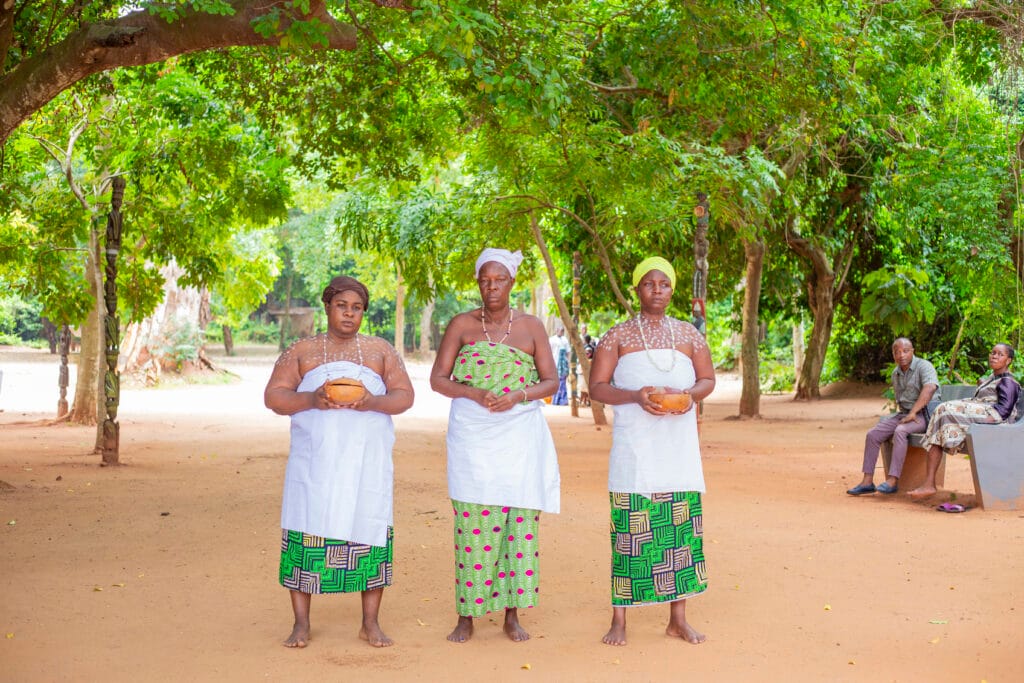
— Editorial cornerstone
Voodoo in Benin — the living religion its people call Vodun
Vodun
A way of knowing
Not a costume. Not a cult. A living religion of Benin and its Atlantic diaspora — the answer to the question most travellers arrive with.
— Editorial cornerstone
Vodun (also written Vodũ, Vodou, Vudu, Vodum) is the culture of the Fon, Ewe, Gun and Yoruba peoples of Benin, Togo and southwest Nigeria — and the religion that culture produced. The same body of knowledge also produced their medicine, their art, their philosophy and their law. About 11.6% of Beninese declared Vodun as their religion at the 2013 census, but that counts declaration, not participation: the culture is the ground the whole society stands on. It is recognised by the Beninese state, where 10 January is a national holiday. It is not sorcery, not a cult, and not the “voodoo” of American film.
It is, in every meaningful sense, a major world religion, recognised by the Beninese state, the African Union and UNESCO institutional partners. The word voodoo that European cinema invented in the 1930s has almost nothing to do with what is practised here. This page is our answer to the question most travellers arrive with — what is Vodun, really? — and it is where we set out what the tradition is, before anything else.
— The foundational question
What is voodoo, really?
Vodun is the culture of the peoples of this coast — and the religion that culture produced. It originated on the West African coast — in the region that is today southern Benin, southern Togo, and parts of Ghana and Nigeria. It predates European contact by several centuries; its precise origins are debated, but its codification as a religious system clearly precedes the seventeenth century.
It has a theology — a creator deity (Mawu or Mawu-Lisa, depending on the lineage), and a pantheon of more than 400 vodun (lower-case, deity-spirits) that act as intermediaries between Mawu and the human world. Each vodun has its own attributes, its own ritual calendar, its own community of devotees.
It has a clergy — initiated priestesses and priests (vodunon and vodunsi), organised in lineages and houses, with formal initiation that can take months or years.
It has an ethics — codes of conduct, ritual obligations, prohibitions specific to each lineage, and a strong emphasis on the moral dimensions of interpersonal relationships and ancestral debt.
It has a contemporary practice — daily for the practitioners (about 11.6% of Beninese declare Vodun as their religion; a far larger share participate through their families, their healers and their community obligations), and through the Atlantic diaspora in Haiti (Vodou), Brazil (Candomblé, Umbanda), Cuba (Lucumí, Regla de Ocha, Palo Mayombe), Louisiana (New Orleans Voodoo).
What Vodun is not: a costume, a Halloween motif, a horror trope, an underground cult, a primitive belief, a survival from a pre-modern past. The Hollywood version invented in the 1930s — the doll with pins, the zombie, the dark master — is a colonial fantasy with almost no relationship to the religion. We address this fantasy directly throughout this page because it is the question we receive most often.
— The word
Is Vodun the same as voodoo?
No, though the words are related. “Vodun” is the Fon and Ewe word, and it names the religion as it is practised in Benin, Togo and southwest Nigeria. “Vodou” with a u is the Haitian religion that descends from it. “Voodoo” is the American spelling, and it carries two centuries of Hollywood invention — dolls, pins, zombies — that have no place in Beninese practice.
We use “Vodun” throughout this site. When you see “voodoo” on a tour listing, it is usually a signal that the operator is selling the film version.
— The word, continued
What is voodooism?
Voodooism is not a religion anyone practises. It is a word about a religion, made by outsiders, and no Vodun practitioner in Benin, Togo or southwest Nigeria uses it to describe what they do.
The -ism is the tell. English attaches that suffix to things observed from a distance and classified from outside, and it turns a way of living into a doctrine to be catalogued. The word circulated in the nineteenth-century American press, largely in coverage of New Orleans, and by then it had already absorbed everything the cinema would later monetise: the dolls, the pins, the curses, the night rites.
The religion’s own name is Vodun. In Fon and in Ewe the word means spirit, or deity, or the force moving through a thing. There is no -ism in it, because there was never a system waiting to be named from outside — only a way of living alongside the spirits who are already here.
So if you arrived searching for voodooism, you have the right subject under the wrong name. The difference between Vodun, Vodou and voodoo is where to start.
— The frame
Is Vodun a religion or a culture?
Both, and the order matters. Vodun is first the culture of the peoples of the Bight of Benin — the Fon, the Ewe, the Gun, the Yoruba and their neighbours. Out of that culture came a religion, but also a pharmacopoeia that remains the primary medicine of much of the countryside, a sculptural and textile tradition, a body of proverb and philosophy, and a system of oath and arbitration that ran justice long before the colonial courts arrived.
Treating Vodun as only a religion is a European habit of mind, one that sorts the world into faith on one side and culture on the other. That division does not exist here. A Beninese family can be Catholic on Sunday and still bring a newborn to the vodunon for the naming, still settle a land dispute by oath, still use the plants. Asking which of the two boxes they belong in is the wrong question.
This is why census figures understate Vodun so badly, and why we describe it on this site as the culture of a region rather than the faith of a minority.
— By the numbers
How many people practise Vodun?
It depends on what you count. At the 2013 census — the most recent for which religious data has been published — 11.6% of Beninese declared Vodun as their religion, roughly 1.2 million people, with far higher proportions along the southern coast around Ouidah, Abomey and Porto-Novo. The 2002 census had put the figure at 17.3%. The fall reflects a change in how people declare themselves, not a change in what they practise.
Declaration is not participation. Our own estimate, from working this coast, is that more than 70% of Beninese households — Christian and Muslim ones included — still call on Vodun priests for consultation, healing, oath and the naming of children. The census counts the box a person ticks. It does not count who walks into the convent.
Across the Atlantic, the descendant traditions are larger again: Haitian Vodou, Bahian Candomblé and Cuban Regla Arárá. Figures for the whole Vodun family worldwide, West Africa and diaspora together, are commonly given as around 60 million, though no census supports a number that precise.
— The cosmology
Does Vodun have one God or many?
One. This is the first thing outsiders get wrong. Vodun is not a pantheon of rival gods in the Greek or Roman sense. It holds that there is a single unique God, creator of everything, who was himself never created — the beginning and the end of all things. Fon tradition calls him Mawu, or Mawu-Lisa depending on the lineage.
What differs from the Abrahamic faiths is what comes next. This God is understood as too vast, and too occupied with the whole of creation, to be petitioned directly over the ordinary business of a single human life. He has therefore delegated his responsibilities. The vodun — the several hundred entities whose names fill the rest of this page — are not his competitors. They are the offices through which his authority is exercised. Each holds a portfolio, each answers for a domain, and each can be approached by name.
So the honest answer to “how many Vodun gods are there?” is: one God, and many delegated powers. Counting the vodun and reporting the total as a number of gods is like counting a government’s ministries and concluding the country has forty heads of state.
— The delegated powers
Who are the main Vodun gods?
Four are held to be the greatest of the delegated powers. Between them they hold the material world — earth, fire, air and water.
- Sakpata — the vodun of the earth. He also holds authority over diseases of the skin, smallpox above all, and over the healing of them. Across southern Benin he is the most carefully served of the four.
- Hebiosso (also written Heviosso, Xevioso) — the vodun of fire. Thunder and lightning are his. A person struck by lightning is understood to have been taken by Hebiosso, and the rites that follow belong to his house.
- Dan — the vodun of air. He is met in the form of the serpent and of the rainbow — Dan Ayidohwedo, the rainbow-serpent — and he carries movement, breath, continuity and wealth.
- Tohossou — the vodun of water, and also the vodun of twins and of children born with unusual bodies. In Dahomey the royal tohossou held a rank close to the throne.
Alongside the four sit several hundred more vodun, each holding its own defined office — a trade, a river, a forest, a market, an illness, a task. Two are named here only because they are the two a visitor is most likely to meet:
- Gu — the vodun of iron. Anything made of iron or done with iron falls to him: the forge, the blade, the hunt, the surgeon’s hand, and now the engine and the workshop.
- Legba — the intermediary. Nothing reaches any other vodun except through Legba, and no ceremony opens without him. He carries the message between the human world and every other. His shrine stands at the entrance, the crossroads and the threshold, which is exactly where his work is. He is not a devil, whatever the films have told you. He is the door.
Gu and Legba are examples, not the list. The others are not lesser versions of them: each holds a full office of its own, and which of them a given family serves depends on where it lives, what it does and whom it descends from. And above all of them, in the daily life of an actual family, stands a category outsiders almost never hear about.
— The ancestors
What is an eponymous Vodun?
The most important vodun in a Beninese family’s life is usually not one of the four. It is the family’s own.
An eponymous vodun is the first ancestor identifiable in a lineage — the far-off founder who established the line and set the dos and don’ts that everyone born into it still observes — raised to the status of a deity after his death. He is revered by his descendants and by no one else.
His authority comes from proximity. The four great vodun answer for the world. The eponymous vodun answers for you: he knows the family, he wrote its rules, and he is joined to the people calling on him by blood. In Vodun, blood is the strongest channel of intermediation there is. A request routed through your own ancestor carries further than one routed through a vodun who owes you nothing.
Which is why the dead are not all equal here. Not everyone becomes an ancestor worthy of praise. Dying does not confer it. It is granted only to the remarkable — those who founded something, held the line through something, or left the lineage stronger than they found it — and it is granted by the living, generation after generation, who decide whose name is still worth calling. The rest are mourned, buried and remembered as family. Only some are elevated.
— A short history
From the Kingdom of Allada to UNESCO heritage
The institutional history of Vodun runs in parallel to the history of the West African coast itself. The Kingdom of Allada, founded around 1100 CE, was already organised around Vodun ritual structure. The Kingdom of Dahomey, founded around 1620, codified the relationship between political authority and Vodun cosmology — the king (Houegbadja, Agaja, then their successors) ruled with the spiritual authority of the vodun his lineage was tied to.
| Period | Milestone |
|---|---|
| Before 1620 | Kingdom of Allada — Vodun as institutional spiritual structure of the Aja-Fon kingdoms. |
| 1620 | Foundation of the Kingdom of Dahomey by Houegbadja — Vodun as political-spiritual matrix. |
| 1727–1733 | Dahomean conquest of the coast — Vodun crosses the Atlantic with the transatlantic slave trade; the diaspora religions are born. |
| 1791–1804 | Haitian Revolution — Vodou recognised retroactively as a spiritual force of resistance and political organisation in the Caribbean diaspora. |
| 1894–1900 | French colonial pacification — Dahomean Vodun structure persists despite colonial repression of certain public ceremonies. |
| 1960 | Independence of Dahomey (renamed Benin in 1975) — Vodun reclaims public presence. |
| 1996 | Benin officially recognises Vodun and decrees the first national Vodun Day — the state itself remains secular. |
| 2017 | UNESCO recognition of the Slave Route project Ouidah as Memory of the World heritage — Vodun cosmology and the slave trade inseparable in the international memory framework. |
| 2027 | Vodun Days now runs as an eight-day festival, 2–9 January — Benin positioning Vodun heritage as both spiritual practice and cultural patrimony. |
The timeline above is necessarily compressed. The sections below take up five dimensions in turn — political authority, the diaspora dispersal, the entanglement with the slave trade, and the contemporary practice.
— Five dimensions
The five dimensions we go deeper into
1. Understanding Vodun
What Vodun is — and what it is not. The foundational definitions, the cosmology (Mawu, the pantheon, the clergy), the daily practice. This is written for a reader who has never encountered Vodun seriously before. It is also the entry point for educators, journalists, and operators preparing groups.
2. Vodun and Political Power
The Kingdom of Dahomey and the structural braiding between political authority and Vodun spiritual structure. From the foundation of Allada through the Dahomean conquest of the coast, Vodun was inseparable from how power was held, transmitted, and contested. That braiding runs through colonial repression to contemporary Beninese state recognition.
3. Vodun and the Diaspora
Haiti (Vodou), Brazil (Candomblé, Umbanda), Cuba (Lucumí, Palo Mayombe), Louisiana (New Orleans Voodoo). The transatlantic slave trade dispersed Vodun across the Americas, where it adapted, mixed with other African and Indigenous religious systems, and persists today. Those dispersals, and the practices they became, belong to the same history.
4. Vodun and the Slave Trade
The historical entanglement between Vodun ritual structure and the Dahomean role in the transatlantic slave trade. We do not flinch from this entanglement. The Dahomean kingdom was both Vodun in its political-spiritual organisation and a major supplier of captives to European traders. The two facts must be held together.
5. Vodun Today
Contemporary Vodun practice — daily life of practitioners, the role of Benin Tours, the relationship with tourism and Vodun Days, the contested questions (folklorisation, commodification, photography ethics, ceremony access). This dimension belongs to the present, not the past.
Five dimensions, one religion. Each is a starting point for a different kind of conversation.
— Across the Atlantic
Vodun is also the religion of Haiti, Brazil, Cuba and New Orleans
The transatlantic slave trade — particularly between 1701 and 1850, when an estimated 1.2 million Africans were forcibly embarked from the Bight of Benin coast — carried Vodun practitioners, initiates, and ritual knowledge across the Atlantic. In the conditions of slavery, Vodun adapted, mixed with the religious systems of other African peoples brought to the same colonial spaces (Yoruba, Kongo, Igbo, Fula), and with Indigenous American and European Catholic elements.
The coast those captives left is documented in our field notes on the Slave Route and the Door of No Return at Ouidah.
In Haiti, the result was Vodou — officially recognised as a religion in Haiti since a 2003 presidential decree, and central to the Haitian Revolution of 1791–1804 that founded the first Black republic in the Americas. The Bois Caïman ceremony of August 1791, where the revolution was sworn, was a Vodou ritual.
In Brazil, Candomblé (in Bahia and the Northeast) and Umbanda (in the Southeast) carry Vodun lineages alongside Yoruba and Kongo religious traditions. Brazilian Candomblé counts an estimated 1.7% of the Brazilian population (over 3 million people) as adherents.
In Cuba, Lucumí (also called Regla de Ocha) carries Yoruba and Vodun lineages; Palo Mayombe carries Kongo lineages. Both are central to Cuban culture and music — son, rumba, and contemporary Cuban jazz are inseparable from these religious practices.
In Louisiana, New Orleans Voodoo (also called Louisiana Vodou) is the syncretic religion that emerged from the Haitian refugee influx after the Revolution and the existing African presence in the French Catholic colonial system. It is distinct from Haitian Vodou and from Beninese Vodun, but lineally connected to both.
The diaspora dimension is essential for understanding the contemporary place of Vodun. It is not a regional religion of West Africa; it is one of the spiritual foundations of the Black Atlantic.
Vodun is one of the spiritual foundations of the Black Atlantic — not a regional curiosity.
— Vodun today
The contemporary practice
Vodun is practised today in Benin by 11.6% of the population as their declared religion, and as a continuous cultural matrix for the great majority. Benin is a secular state; it has nonetheless officially recognised Vodun since 1996, and 10 January is a national public holiday (law no. 97-031 of 20 August 1997). The annual Vodun Days festival in Ouidah every January is one of the largest religious-cultural events in West Africa, drawing pilgrims and visitors from across the diaspora.
The contemporary practice has its own tensions, which we name honestly:
Folklorisation
The risk that Vodun is reduced to a tourism product (transes for cameras, festivals as performances). Heritage and Routes works against this directly. The question we keep returning to is what makes a Vodun encounter respectful rather than extractive.
Commodification
The question of payment, gift, and exchange in Vodun ritual life. Our programmes use the word honorarium for what is given to communities, not fee. This is not semantic — it reflects the cosmological structure where gift, debt, and reciprocity are central.
Photography ethics
The long-running tension between outside documentation and ritual privacy. Our policy is consultative: the practitioners decide what is photographable and what is not, in real time. The pre-trip briefings for our programmes go into this in detail.
Ceremony access
The question of which rituals are open to outside witnesses and which are not. The answer is held by the practitioners. Our programmes work within their decisions, not around them.
These tensions are not solved. They are managed, daily, by the communities and by the institutional structures (the academic partners, the cultural ministry). To travel honestly with Vodun is to enter this management process, not to bypass it.
— Travel with us
Two ways to encounter Vodun with Heritage and Routes
The 7-day Vodun journey
Our flagship Vodun-focused programme, across Benin and Togo. From the Temple of Pythons in Ouidah to the Akodessawa Fetish Market in Lomé. Accompanied by initiated practitioners, scholars and elders. Designed for groups of 4 to 10. It is one of our journeys in Benin.
Vodun Days — January editions
Our adapted programme around the annual Vodun Days festival in Ouidah. Combining the public festival ceremonies with restricted-access moments. A 7 to 10-day format, January only.
For deeper reading first
If you are not ready to travel yet, this page is an extended primer. The Field Notes category Vodun heritage publishes a long-form piece every month.
Explore the 7-day Vodun journey → Subscribe to Field Notes →
— Further reading
Selected bibliography
A non-exhaustive selection, organised in four categories.
Foundational academic works on Vodun
- Akinjogbin, I. A. Dahomey and its Neighbours, 1708–1818. Cambridge University Press, 1967.
- Law, Robin. The former Slave Coast of West Africa, 1550–1750. Oxford University Press, 1991.
- Soumonni, Elisée. Dahomé et le monde atlantique. Karthala, 2003.
- Bay, Edna G. Wives of the Leopard: Gender, Politics, and Culture in the Kingdom of Dahomey. University of Virginia Press, 1998.
Vodun cosmology and contemporary practice
- Apter, Andrew. Black Critics and Kings: The Hermeneutics of Power in Yoruba Society. University of Chicago Press, 1992. (Relevant for the Vodun–Yoruba spiritual axis.)
- Capone, Stefania. Searching for Africa in Brazil. Duke University Press, 2010.
- Hurbon, Laënnec. Le Vaudou : Pouvoir Magique et Société. Albin Michel, 1972. (Foundational on Haitian Vodou.)
- Murphy, Joseph M. Working the Spirit: Ceremonies of the African Diaspora. Beacon Press, 1994.
Vodun and the Atlantic slave trade
- Heywood, Linda M., editor. Central Africans and Cultural Transformations in the American Diaspora. Cambridge University Press, 2002.
- Sterling Stuckey. Slave Culture: Nationalist Theory and the Foundations of Black America. Oxford University Press, 1987.
- Manning, Patrick. Slavery, Colonialism and Economic Growth in Dahomey, 1640–1960. Cambridge University Press, 1982.
Contemporary issues
- Falola, Toyin and Ann Genova, editors. Orisa: Yoruba Gods and Spiritual Identity in Africa and the Diaspora. Africa World Press, 2005.
- Reports from the Beninese Ministry of Tourism, Culture and Arts on Vodun Days (annual since 1996).
- Academic publications from the Université d’Abomey-Calavi, the University of Lomé, the EHESS Religions afro-américaines, and the Centre d’études africaines (CNRS).
— Common questions
Frequently asked questions about Vodun
Is Vodun recognised as a religion?
Yes. By the Beninese state since 1996. By the Haitian state. By the African Union. By the United Nations system. By every major academic religious studies department. The question is sometimes asked because of the long history of European dismissal of African religions as superstition or animism — that dismissal is academically and institutionally obsolete.
Who is the supreme deity?
Mawu (sometimes Mawu-Lisa, in the dual conception of a creator deity). Mawu is the creator of everything and was himself never created — the beginning and the end of all things. Because he is understood as too vast to be petitioned over the business of a single life, he has delegated his responsibilities to the vodun (lower-case, more than 400 of them), who act as intermediaries in specific domains. Vodun is therefore best described as one God with many delegated powers, not as a pantheon of rival gods.
How many Vodun gods are there?
There is one God — Mawu, the uncreated creator. Below him are the vodun, more than 400 of them, who are not gods in competition with him but delegated powers, each responsible for a domain. Four are considered the greatest: Sakpata (earth, and the diseases of the skin), Hebiosso (fire, thunder and lightning), Dan (air, the serpent and the rainbow) and Tohossou (water, and twins). Several hundred others hold offices of their own — a trade, a river, a forest, a market, an illness. Among the most often met are Gu, who holds iron, and Legba, who carries every message between the human world and all the others. Most important of all in the life of a family is its own eponymous vodun, the deified founder of the lineage.
Is there a sacred text?
Vodun does not have a unified written sacred text comparable to the Bible or the Qur’an. Its transmission is primarily oral, through the lineages of initiation, the chants, the divination systems (notably Fa, the Beninese version of the Yoruba Ifa divination), and the ritual codifications passed within the houses. There are extensive written corpora about Vodun (the academic literature in the bibliography section), but the religion itself is not a religion of the book.
Is there a Vodun heaven?
The cosmology has a vertical axis (the creator deity above, the living world below, the world of the dead and the ancestors below the living) and a horizontal axis (the community of the vodun, the ancestors, the human community, all interconnected). Salvation as conceived in Christianity or Islam is not the framework. The framework is ancestral continuation, community standing, and right relationship with the vodun of one’s lineage.
Are there sacrifices in Vodun?
Yes. Ritual sacrifice — of animals, of food, of objects — is a structural part of Vodun practice. It is the exchange that establishes and maintains the relationship between the human community and the vodun. We do not perform it for travellers, do not stage it, and do not avoid it as a topic in conversations. Comparable ritual structures exist in every major world religion.
Can outsiders be initiated into Vodun?
Yes, under specific conditions decided by the practitioners. Diaspora travellers, in particular, are sometimes recognised as having ancestral ties that the practitioners acknowledge. Initiation is a serious and irreversible process, takes months to years, and is not something that can be done as part of a tourism visit. The practitioners explain this clearly when the question is raised.
What is the relationship between Vodun and Christianity in Benin?
Complex. Many practising Vodun adherents are also Catholic or Protestant; the religions are not necessarily mutually exclusive in daily life. There are also Pentecostal currents in Benin that take a strong anti-Vodun position. The Beninese cultural landscape is layered, and we walk in it carefully.
What is the most respectful way to encounter Vodun as a traveller?
Take it seriously as a religion. Read about it before you travel (the bibliography on this page is a starting point). Travel with operators who work with initiated practitioners as partners, not as guides. Accept what is opened to you, and accept what is closed. Put the camera away when in doubt. Listen more than you speak.
— From the journal
From the Field Notes
- Vodun Days 2027 — eight days around the festival Vodun · 11 min read
- The Vodun-aware operator’s checklist Vodun · 8 min read
- Reading Vodun without a translator: a primer Vodun · 12 min read
Vodun is a way of knowing. We treat it as such.
If this page changed how you think about Vodun, that is the journey starting. Subscribe to Field Notes for monthly long-form pieces from the former Slave Coast.
— About the editor
This editorial cornerstone was written and is maintained by Fèmi, founder of Heritage and Routes, based in Cotonou. Heritage and Routes designs memory-focused journeys across the former Slave Coast — Benin, Togo, Ghana, Nigeria — and publishes long-form editorial from the region. The bibliography above is our working library.