
By Fèmi (Oluwafemi Kochoni) · Founder & Cultural Programs Director · Cotonou, Benin · Published 29 August 2026 · 9 min read
The Door of No Return at Ouidah is a memorial arch raised on the beach where, for nearly two centuries, more than a million captives were rowed out to the slave ships. It marks the end of the 4 km Slave Route — and the point where the land of the ancestors ended.
What the Door of No Return actually is
The Door is not a colonial relic. It is a modern memorial: a monumental arch built in the mid-1990s at the ocean end of Ouidah’s Slave Route, as part of the UNESCO Slave Route Project, which was launched at Ouidah in 1994. Benin chose to mark the exact shore of embarkation — not with a museum wall, but with an open gate facing the Atlantic, on the sand the captives actually crossed.
That choice matters. At Gorée or Cape Coast, the “door” is an opening in a fortress. At Ouidah there was no fortress on the beach: ships anchored offshore, beyond the sandbar, and the last steps of the deported were through surf, into canoes. The arch stands over that memory of open sand and water.
Reading the monument
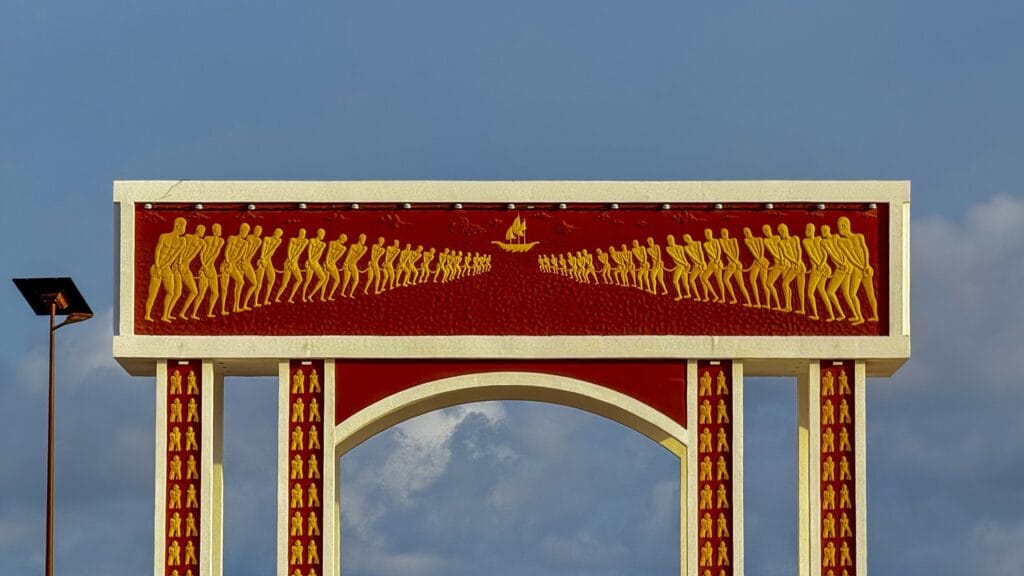
The frieze that crowns the arch shows two long lines of figures, bound at the neck, walking from both sides toward a ship at the centre — the final march, compressed into bronze-coloured relief. The pillars repeat kneeling figures in chains. Everything on the ocean face of the monument walks seaward; stand under the arch and the Atlantic fills the frame it creates.
The inland face answers it with symbols of return and of the spirits — the dead who come back, as Egungun — a reminder that in the Vodun world this shore is not only an ending. Two other monuments nearby complete the grammar: the Tree of Return, around which captives circled so their souls could find the way home, and the memorial at Zoungbodji. We read all of them, station by station, in our guide to the Slave Route of Ouidah.
The shore it marks
Between roughly 1670 and 1860, Ouidah was the largest slaving port of the Bight of Benin and the second of the whole Atlantic trade: over a million people passed down this road. They came manacled from the Auction Square in town, past the tree of erasure, through the confinement of the Zomaï enclosure, to the beach. What the numbers cannot carry, the walk does — 4 km is short enough to walk and long enough to change you.
The site in 2026 — field notes
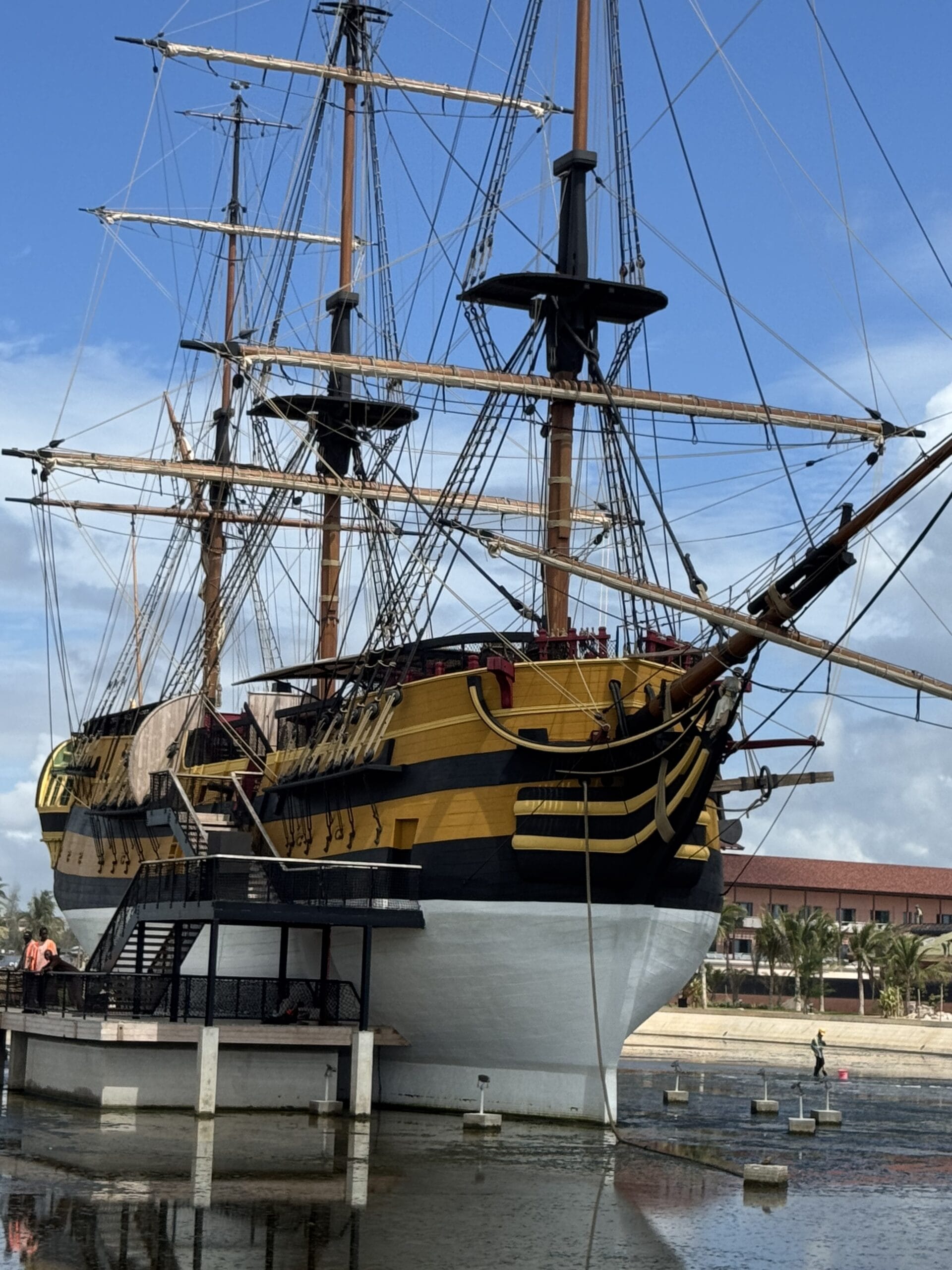
The Door and its esplanade were fully restored in recent years as part of Benin’s rehabilitation of the memorial route. The approach is now a paved plaza; the arch has been repainted and its reliefs regilded; at night the site is lit. A short walk away, a full-scale memorial ship of departure now rides at anchor on the waterfront — by day a dark silhouette, by night a rigging of lights doubled in the water.
Two practical notes from the ground: the Zomaï house is currently being rebuilt, and the Zoungbodji memorial has not yet reopened to the public — our Slave Route guide keeps the current status of every station.
Which Door of No Return is this?
Several places on the Atlantic coast carry the name. The Maison des Esclaves on Gorée Island frames a doorway onto the sea; Cape Coast Castle and Elmina in Ghana have castle gates opened onto the beach; Ouidah’s is the modern memorial arch on the embarkation shore itself. They are not competitors — they are stations of one Atlantic geography. If your journey traces the whole coast, our twelve-day former Slave Coast journey stands at both Ouidah’s Door and Cape Coast’s within a single itinerary.
Visiting the Door
Ouidah is about an hour from Cotonou. The Door can be seen in twenty minutes; it should not be. Walk the Route first — the monument only makes full sense as its final station — and go with someone who can read the reliefs, the orientation, the Vodun grammar of return. Early morning and the last hour of light are the honest hours: fewer crowds, softer heat, and the frieze in relief. During Vodun Days each January, the beach around the Door becomes the centre of the national festival.
One request: this is a memorial. People come here to mourn and to pray, some carrying names of ancestors. Photograph the monument freely; photograph people only with their consent.
Stand there with someone who can read it
The Door is day 2 of our 12-day former Slave Coast journey, and the final station of the Slave Route of Ouidah, which we walk guided, from Cotonou.
Go further