
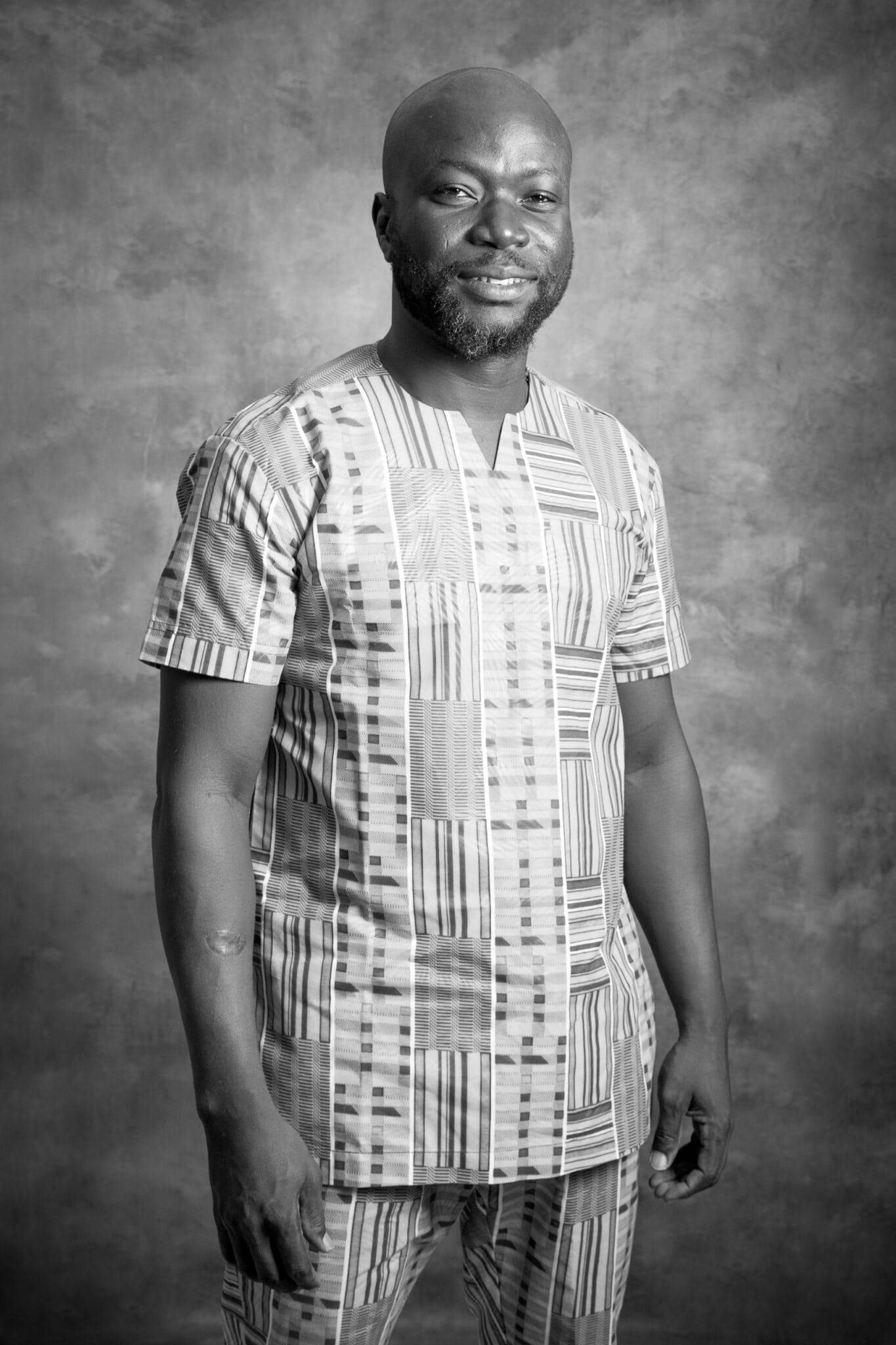
Oluwafemi (Femi) Kochoni
I work memory, not tourism. Based in Cotonou. Accountable here.
Where I work from
I work from Cotonou. The former Slave Coast — Benin, Togo, Ghana, with extensions into Nigeria where the angle demands it — is the field I have walked enough times to be able to write about it with care. Cotonou is not a metaphor for that work. It is the address.
This matters. Heritage and Routes is a Beninese operation. The ground team is here. The relationships with elders, with the Vodun community, with the Beninese academic institutions, with the Ministry of Tourism, Culture and Arts — these are relationships of years, not of programmes. The editorial line I hold reflects that ground.
What I do at Heritage and Routes
I founded Heritage and Routes to design and accompany small-group programmes across the former Slave Coast for clients who want a serious editorial-operational frame around their journey. Four things sit at the centre of what I do.
Programme design. I hold the design of the three flagship programmes — the 12-day former Slave Coast journey, the 7-day Vodun journey, and the 10-day custom programme — and the editorial cornerstones of the site (Vodun heritage hub, the former Slave Coast cornerstone in development). The custom proposals that go out to clients are mine, or are reviewed by me before they leave.
Editorial line. The voice of Heritage and Routes — what we write, how we write it, what we publish and what we hold back — is mine. The Field Notes long-form pieces are written by me or commissioned by me; the cornerstones are anchored on a specific editorial position I have defended for years.
Ground accompaniment. I accompany most of the programmes on the ground. Not as a guide — that role belongs to the elders and scholars who carry the lineages — but as the operator-level presence that holds the programme together. The discovery calls, the proposal calls, the pre-trip briefings, and the post-trip debriefs are mine.
Institutional partnerships. The B2B relationships with operators, the institutional relationships with universities and foundations, the editorial partnerships with documentary teams — these run through me.
Why memory operator, not tourism operator
I do not describe Heritage and Routes as a tourism operator. The word does not carry what we do. We accompany memory work — for diaspora travellers walking ancestral routes, for academic delegations writing about the trade and its afterlife, for documentary teams documenting Vodun and the former Slave Coast, for institutional groups taking the long view.
The distinction matters operationally. A tourism operator optimises for the traveller’s comfort and the company’s margin. A memory operator optimises for the integrity of the encounter — what is shown, what is not shown, who decides, how the communities encountered are treated, how the memory is held. The two priorities frequently conflict. I have chosen the memory side.
This position is not a marketing flourish. It is the operational reason our programmes work on the editorial level they do — and it is the operational reason we sometimes turn down work that would compromise it.
Training, partnerships and accountability
My full name is Oluwafemi Kochoni. I am the founder of Heritage and Routes, based in Cotonou. The credentials below are the framework within which I work.
I hold a licence in African and Diaspora Studies from the Faculté des Lettres of the Université d’Abomey-Calavi, the principal academic centre for West African historical studies in Benin. I trained as a certified guide in cultural and memorial tourism. I worked for several years alongside Professor Honorat Aguessy at the Institut de Développement et d’Échanges Endogènes (IDEE) in Ouidah — a foundational period for the editorial position I hold today.
- Tour direction & cruise operations — I work as a Tour Director for Odysseys Unlimited and Grand Circle, two of the leading American tour operators, and I head cruise ship ground operations in Benin. For the 2026 season, I directed and coordinated the operations of 5 of the 7 cruise ships that called at Benin.
- University affiliations — Université d’Abomey-Calavi (Benin), Université de Lomé (Togo), University of Iowa (USA), Wageningen University and Research (Netherlands) — for programme partnerships and field accompaniment.
- Institutional coordination — working relationships with the Ministry of Tourism, Culture and Arts of Benin, as well as the local authorities of Ouidah, for the coordination of public ceremonies and the ethical negotiation of access to ritual sites.
- Editorial commitment — the integrity of the encounter takes priority over traveller comfort. Programmes are designed to serve memorial work, not to optimise margin.
Writing
The Field Notes long-form pieces are where the editorial line of Heritage and Routes lives in writing. The pieces by me are signed; the commissioned pieces are framed and edited by me. The catalogue currently builds across four categories — Memory & History, Vodun heritage, Operator Notes, The Coast Today — and the writing rhythm is one long-form piece every two weeks.
For first readers, the entry points are the cornerstones — particularly the Vodun heritage hub and its five sub-pages — and the most recent Field Notes pieces in the Field Notes hub.
How to reach me
For programme enquiries — the 12-day former Slave Coast, the 7-day Vodun, the 10-day custom — the entry point is the discovery call. A 90-minute video conversation with the person who is piloting the group. We respond to discovery call requests within 48 hours. For other enquiries — press, institutional partnerships, documentary projects — the same channels apply with slightly different lead times.
Email is the right channel for first contact. The Contact page holds the routing — programme enquiries, editorial enquiries, B2B partnerships — and the discovery call form.
On the networks: LinkedIn.
Articles signed by Femi
The catalogue builds across five editorial clusters that feed into each other. Here are the pieces that structure the work to date.
Memory & History — the Slave Route of Ouidah
- Slave Route of Ouidah — walking memory on the Bight of Benin coast — editorial pillar, ten stations, four kilometres, two centuries
- Vodun Today — the transatlantic reading of the cult
Vodun Days — Ouidah, January
- Vodun Days — the Beninese state festival of Vodun — editorial cornerstone
- Vodun Days 2027 — six days around the festival — January 2027 edition with Sahouè-Doutou access
- What Vodun Days actually celebrates — a primer for the curious traveller
- Houngans, hounsi, vodunon — the working hierarchy of a Vodun convent
Diasporic festivals — Ghana, Togo, Benin
- PANAFEST and Emancipation Day — Cape Coast, July — primer, field notes, anthropological reading
- Hogbetsotso — Anloga, November — the Anlo-Ewe departure from Notsé
- Agbogbo-Za — Notsé, September — the festival of the Ewe who stayed
- Fetu Afahye — Cape Coast, September — the 77 deities of Oguaa
- Evala — Kara, September — wrestling as ritual
- Porto-Novo Mask Festival — July, Benin
Cult patrimony
- Houngans, hounsi, vodunon — the working hierarchy of a Vodun convent
- Reading Egungun without an initiation
- Guèlèdè at UNESCO — what the 2008 inscription said and didn’t say
- Zangbeto at dusk — a photographer’s notebook from Porto-Novo
Programmes — author-led journeys
- Voodoo Discovery — 7 days with the practitioners