
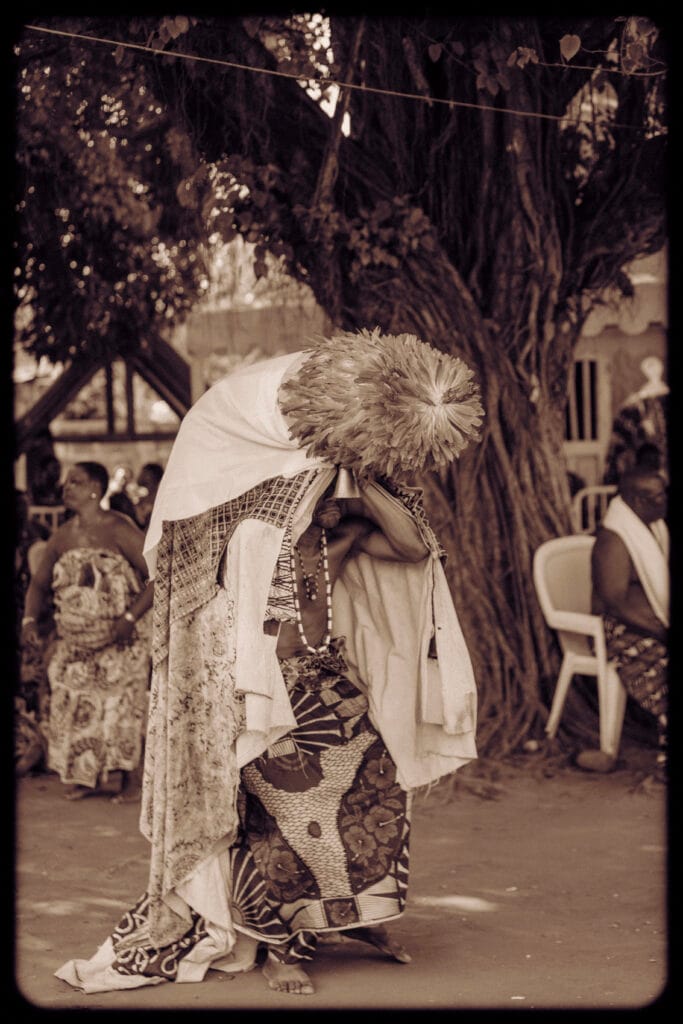
New to the festival? Start with Vodun Days 2027 explained — dates, sites, lineages and how to attend.

Benin’s voodoo festival 2027 — eight days around Vodun Days, from Ouidah’s public rite to Sahouè-Doutou’s initiated chambers
Heritage and Routes welcomes its January 2027 cohort to Vodun Days. Eight days, two poles of Beninese ritual life, three approaches to read them.
Why 2027
Vodun Days comes from a 1996 decree by which Nicéphore Soglo, then president, made 10 January the national day of Vodun. The act reversed decades of administrative marginalisation. For the first time since the colonial period, the Beninese state recognised, celebrated and protected a religion that Christian missions and the French colonial administration had long sought to dismiss as folklore. (The decree is documented in our Vodun Days cornerstone.)
What the decree created was a one-day public holiday. What it has become is something else. Edition after edition the state framework has widened, and the 2027 edition runs eight days, from 2 to 9 January 2027, at Ouidah. The holiday has grown into a festival.
Since 2025, the festival has no longer been held in Ouidah alone. The Guédéhoungué lineage, at Sahouè-Doutou (Houéyogbé commune, Mono department), now holds its own parallel celebration, recognised by the National Vodun Community of Benin — CNCVB-Racine. This is not a schism. It is a division of labour. Ouidah holds the cultural public side — processions, animations, concerts. Sahouè-Doutou holds the cultic depth, the side of initiates and closed ceremonies.
The Heritage and Routes 2027 journey is built around that articulation. There are not many opportunities, on the West African coast, to hold both dimensions in the same trip.
For travellers arriving from Brazil, Cuba, Haiti, the United States or any other side of the Atlantic diaspora: this is the place where the religion you may know from the other shore is still held in the language and the lineage that carried it across.
An eight-day festival
The 2027 edition runs eight days, from 2 to 9 January 2027, at Ouidah. That is the whole of it — one continuous festival, not a long weekend with a tail. Over those eight days the city moves between registers: civic squares and the beach for the animations and concerts, the six ritual sites for the ceremonies proper, and the surrounding communes for the parallel celebrations.
The rhythm is progressive. The opening days draw the city into convergence — Ouidah residents, diaspora travellers, journalists, scholars, officials from Cotonou. The middle of the festival carries the Great Vodun Ceremony, the moment when the six ritual sites of Ouidah officiate together in public. The closing days return the festival to the Arena and the beach. Which day carries which is the Ministry’s to announce, and we will not guess it for you.
This is also where the clearances we negotiate months in advance come into their own — observation perimeters, photo permissions, introductions to the dignitaries. The work does not show, but it decides what we are allowed to approach.


The six sites and the ten Vodun honoured
| Site | Vodun |
|---|---|
| Place Maro | Egungun (masked Yoruba ancestors) |
| Esplanade of the French Fort | Zangbéto (guardians of the night) · Terreiros do Brasil / Kao (Afro-Brazilian diaspora link) |
| Place Ninsouxwé | Ninsouxwé |
| Sacred Forest of Kpassè | Hounvè · Kabada · Koku · Thron |
| Mami-Beach Temple | Mami & Dan |
| Sakpata Convent | Sakpata |
The geography is the liturgy. The meaning of each Vodun and each site is unpacked in our Vodun Days cornerstone.
Sahouè-Doutou — the Guédéhoungué lineage
An eight-day festival at Ouidah is a great deal of Ouidah. It is not, however, the whole of Vodun Days. Since 2025 the festival has a second pole, and our cohorts give it a full day of its own.
That day is spent at Sahouè-Doutou, in the Houéyogbé commune, Mono department, three hours west of Ouidah by road. It is the seat of the Guédéhoungué lineage. It is here, in this sacred forest, that the Beninese national day of Vodun takes its source.
Sossa Guédéhoungué, who died in January 2001, was the high Vodun priest who pressed — politically, spiritually, diplomatically — for the religion to obtain state recognition in 1996. As the first president of the National Vodun Community of Benin, he was received in audience by Pope John Paul II at the Vatican at a time when few Vodun dignitaries were welcomed in international institutional settings. His tomb, at Doutou, is now a place of pilgrimage. The 1996 decree is, in significant measure, his decree.
His successor, His Majesty Agassa Adanyro Guédéhoungué, current president of CNCVB-Racine, has held a parallel Vodun Days celebration at Sahouè-Doutou since 2025. The difference is explicit, and the lineage names it directly: Ouidah presents Vodun to a public audience, in its cultural register; Sahouè-Doutou holds it in its cultic register — the side of initiates, of closed ceremonies, of transmissions that do not explain themselves and that media coverage does not capture.
The journey, day by day
Here is how our cohorts build the eight-day journey around the festival. We give the days as Day 1 to Day 8 rather than as calendar dates: the sequence is fixed, and the exact alignment with the Ministry’s programme is confirmed once that programme is published.
Day 1 — Cotonou and Ganvié
Arrival and transfer. Morning in Cotonou: the Dantokpa Market, the largest open-air market in West Africa, where the city shows itself in its full economic intensity, and Place de l’Amazone, whose monumental statue honours the women warriors of the Dahomey kingdom. Afternoon to Ganvié, the stilt village on Lake Nokoué, founded by the Tofinu to escape Dahomey slave raids in the 17th and 18th centuries. Reading in mirror with Ouidah: Ganvié is the refuge, Ouidah is the port. The two tell the same era from opposite sides. End-of-day briefing on logistics, the table of contents for the trip, and the one conversation that matters most — what you have come looking for, and what we can honestly offer you.
Day 2 — Porto-Novo and the Rivière Noire
One hour east. Porto-Novo in the morning: the Grand Mosque, built on the plans of a baroque church by the agudás — descendants of freed enslaved people who returned from Bahia in the 19th century; the Honmé Museum, the royal palace of King Toffa; the Grand Market, run on the Goun traditional calendar. Porto-Novo gives the context that Ouidah does not — the Slave Coast read along the Atlantic return route, not only the departure route. In the afternoon, the Rivière Noire, whose black water — a mineral anomaly rather than a cult — is one of the natural curiosities of the region. Back to Cotonou by evening.
Day 3 — Togo: Lomé
West along the coast and across the border. Lomé gives the cohort a second capital and a second colonial layer — German, then French — against which to read Benin. The Akodessewa fetish market, the largest of its kind in West Africa, is the working supply chain of Vodun pharmacopoeia rather than a curiosity: skulls, roots, dried animals and minerals sold to practitioners who know exactly what each is for. We visit it with a Togolese guide who can name the transactions instead of dramatising them. Afternoon in the Grand Marché and along the seafront.
Day 4 — Togo: Togoville
North-east of Lomé, on the shore of Lake Togo. Togoville is where the 1884 German protectorate treaty was signed with Mlapa III — the act that gave the country its name — and it is also one of the oldest continuous Vodun sites on this coast, with shrines standing a few hundred metres from a German-built cathedral. The two are not in competition here; they are in daily negotiation. Crossing the lake by pirogue is part of the visit. Return towards the Benin border in the evening.
Day 5 — Sahouè-Doutou
A full day with the Guédéhoungué lineage at Sahouè-Doutou, Houéyogbé commune, Mono department: access to the cultic ceremony, introduction to the initiates, direct transmission — within the private protocol Heritage and Routes negotiates in advance with His Majesty Agassa Adanyro Guédéhoungué (see the section above). Silence is expected in places. Photography is negotiated on site, ceremony by ceremony, and sometimes refused. This is the initiated register of the festival, and it is the reason the journey is built the way it is. Transfer to Ouidah at the end of the day.
Day 6 — Ouidah
The cohort settles into the festival city. Depending on the Ministry’s programme, this is either the opening of the public ceremonies or their build-up: the squares and the beach come alive from the morning, and the evening carries a major concert with Beninese and international artists. We use the day to walk the town before the crowds thicken — the Sacred Forest of Kpassè, the Python Temple, the Portuguese fort. We do not lock the cohort into the festival’s rhythm. We also leave room for silence.
Day 7 — Ouidah
The dense day. The six ritual sites of Ouidah officiate. Our advance clearances become active on the observation perimeters, the relations with the high priests, the questions that can or cannot be asked. The Great Vodun Ceremony and the cultural performances fall in this stretch of the festival — the dramatic peak. Debrief after dinner. It is the longest evening of the trip.
Day 8 — Ouidah
The closing day, and the one we hold most deliberately. The Route des Esclaves on foot — the four kilometres from the auction square to the Door of No Return, with the Tree of Forgetting, the Tree of Return and the Zomaï memorial along the way — read at walking pace and in full, not as a photo stop. Celebrations at the Ouidah Arena in the afternoon, and the closing on the beach in the evening. Departures, or extension into Ghana.
Extending into Ghana
Togo is now inside the journey rather than beside it — Lomé and Togoville are Days 3 and 4. The remaining extension is westward, into Ghana. No major festival is held there in January — PANAFEST and Emancipation Day are at Cape Coast in July, Hogbetsotso in Anloga in November, Evala in the Kara region in July, Agbogbo-Za in Notsé in September. The January extension is therefore memorial and cultural rather than festival-driven: Cape Coast Castle, Elmina, and a story no other West African site tells in mirror with Ouidah.
Travellers who want more of the Togolese coast can also add Aného and Glidji, where the annual sacred stone of the Guin is kept, on either side of the eight days.
These extensions are built on our existing cornerstones — Slave Coast Journey 12 days, Voyage Côte des Esclaves 12 jours (FR equivalent) — adapted to the modular format of the Vodun Days 2027 journey. To discuss during the discovery call.
How we accompany the 2027 voodoo festival
The Vodun Days 2027 journey is offered in a format that differs from our all-inclusive cornerstone trips.
Heritage and Routes services only: editorial briefings, advance clearances and private protocol with the Guédéhoungué lineage for Sahouè-Doutou, ground transport across the full circuit (Cotonou → Ganvié → Porto-Novo → Lomé → Togoville → Sahouè-Doutou → Ouidah), border formalities and cross-border coordination for the two Togo days, daily debriefs, coordinated access to the six ritual sites of Ouidah.
Accommodation and meals at your discretion. We recommend a few guesthouses in Ouidah, Cotonou, Porto-Novo and Lomé we have worked with for years — we share the contacts, you book directly. The format makes the trip accessible to travellers who want our access and our orchestration but prefer to keep a hand on their lodging and their table.
Cohort of 6 to 12 travellers maximum. Booking at least four months ahead — the rooms and the Sahouè-Doutou coordination fill quickly. A written proposal, with the price for the eight-day format, follows a discovery call.
Logistics for January in Benin and Togo
Climate. January is the dry season. The Harmattan descends from the Sahel — dust in the air, cooler nights around 22 °C, daytime around 30–32 °C. Light layers, closed shoes for the Sacred Forest of Kpassè and the road to Sahouè-Doutou, modest dress at temple sites.
Visas. Benin issues an e-visa online for most European, North American, and African passports. Processing takes a few days at the official site evisa.gouv.bj. Around 50 EUR for a tourist visa. Togo requires its own entry visa, separate from the Beninese one — obtainable online or on arrival at the land border, and we handle the paperwork for the cohort ahead of Day 3. Check that your passport has enough blank pages for two sets of stamps.
Vaccinations. Yellow fever vaccination is required for entry to both Benin and Togo. We also recommend hepatitis A, typhoid, and an anti-malarial prophylaxis.
Photography. Each ritual site has its own rule. Some allow at a distance, some forbid the image, some require an offering before the shutter. We brief each morning. At Sahouè-Doutou in particular, photography is subject to the explicit authorisation of the Guédéhoungué.
Languages. Briefings in English or French. On the ground, our hosts translate between Fon, Goun, Yoruba, Ewe and the working language of the cohort.
Frequently asked questions
What are the dates of Vodun Days 2027?
Vodun Days 2027 runs eight days, from 2 to 9 January 2027, at Ouidah, Benin.
How long is Vodun Days?
Eight days. The 1996 decree originally fixed a single public holiday on 10 January; the celebration has since grown, edition after edition, into an eight-day state festival.
What is the difference between Vodun Days at Ouidah and at Sahouè-Doutou?
Ouidah holds the cultural public side — processions, animations, concerts, performances. Sahouè-Doutou holds the cultic depth — initiates, closed ceremonies, transmissions — under the lineage of the Guédéhoungué. Both celebrations have been recognised by CNCVB-Racine since 2025.
How do you access the Guédéhoungué ceremony at Sahouè-Doutou?
Access is by private protocol that Heritage and Routes negotiates in advance with His Majesty Agassa Adanyro Guédéhoungué. Our cohort is capped at 12 travellers; places close months ahead of departure.
How long is the Heritage and Routes Vodun Days 2027 journey?
Eight days, Day 1 to Day 8, built around the eight days of the festival: Cotonou and Ganvié, Porto-Novo and the Rivière Noire, Lomé and Togoville in Togo, a full day at Sahouè-Doutou, then Ouidah through to the close of the festival.
What does a Heritage and Routes Vodun Days 2027 journey include?
Heritage and Routes services only — editorial briefings, advance clearances, private protocol at Sahouè-Doutou, ground transport across the full eight-day circuit including the two Togo days, and daily debriefs. Accommodation and meals at your discretion. Cohort of 6 to 12 travellers maximum. The price for the eight-day format is quoted in the written proposal that follows a discovery call.
Further reading
- Editorial cornerstone: Vodun Days — the Beninese state festival of Vodun, at Ouidah, every January. The origin of the 1996 decree, the architecture of the festival, the meaning of each ritual site.
- Vodun Days primer: What Vodun Days actually celebrates — a primer for the curious traveller. The long reading of what the festival does, and does not.
- Memory and history: Houngans, hounsi, vodunon — the working hierarchy of a Vodun convent. The ranks to know before entering a temple.
- Ouidah pillar: The Slave Route of Ouidah — full guide, ten stations, four kilometres. The memorial context that underlies the geography of the festival.
- Vodun and the diaspora: Vodun Today. The transatlantic reading — Brazil, Cuba, Haiti, the United States — that illuminates the presence of the Terreiros do Brasil at Vodun Days.