
By Fèmi (Oluwafemi Kochoni) · Founder & Cultural Programs Director · Cotonou, Benin · Published 8 September 2026 · 8 min read
Travellers write to us asking when the Togo voodoo festival is. There is no single answer, because there is no single festival. Togo has no equivalent of Benin’s Vodun Days. What it has is a New Year rite that UNESCO recognised in December 2025, a warrior festival that moves with the lunar calendar, and Vodun practised every ordinary week of the year.
The short answer: Togo has no Vodun Days
Benin fixed a date. Since 1992 the tenth of January has been a national holiday for traditional religions, and Ouidah turned it into a festival that now runs a full week — 2 to 9 January 2027. Togo did nothing of the kind. Its Vodun never became a state calendar item, and it never acquired a beachfront main stage.
That is worth understanding before you book a flight. If you are looking for a festival in the sense of a programme with dates, a site and a crowd, you are looking for Benin. If you are looking for Vodun as it is actually practised on the Gulf of Guinea, Togo is the better country, and the two are three hours apart by road.
Epé-Ekpé: the taking of the sacred stone at Glidji
This is the closest thing Togo has to a great annual Vodun gathering, and it is not marketed as one.
Epé-Ekpé is the New Year of the Guin (Gen) people of the south-east coast, around Aného and Glidji. It is not a day but a cycle: roughly twenty rites spread over some seven months. The 363rd edition opened at Aného on 7 August 2026. Its culminating rite, Kpéssosso, is the taking of a sacred stone from the sacred wood at Glidji-Kpodji, performed by priests before a crowd that waits in silence for the colour to be shown.
The colour is the message. White announces peace and prosperity; blue, abundant harvests; red, a year of war and want. On Thursday 3 September 2026 the stone came out white — the reading given for the year now beginning. The rite has been performed since 1663, when the Guin arrived from what is now Ghana.
In December 2025, UNESCO inscribed the rites of the Guin New Year on the Representative List of the Intangible Cultural Heritage of Humanity — Togo’s third inscription, after the Gèlèdè oral tradition and Maïeutique, both of them multinational files. Two other rites of the same cycle are worth naming, because they are the ones a visitor can actually enter: Yêkê-Yêkê, the communal meal, and Kpanchonchon, a parade in which faces and bodies are painted and speeches are sung.
When to plan. The taking of the stone falls on a Thursday in early September; the surrounding cycle begins in August. We confirm the exact date with Aného each year rather than publishing a prediction — the calendar belongs to the priests, not to a tourism board.
Adossa-Gadao at Sokodé: the knife festival
Six hours north of the coast, the Tem (Kotokoli) of Sokodé hold Adossa-Gadao. Gadao thanks the ancestors for the harvest; Adossa, the knife dance, is an initiatory festival descended from the sémassi warriors, who proved their power by submitting to trials of the body.
Be clear about what this is. Sokodé is heavily Islamised, and Adossa-Gadao is set by the Islamic lunar calendar — the third month of the lunar year. It therefore slides by about eleven days annually and has no fixed month: the 2026 edition peaked on Saturday 10 January. Calling it a voodoo festival, as several travel sites do, misdescribes it. It belongs to a different religious world, and it is spectacular on its own terms.
What you can see in Togo any week of the year
This is the part the festival question misses. Vodun in Togo is not concentrated into two dates; it is the ordinary religious life of the coastal south.
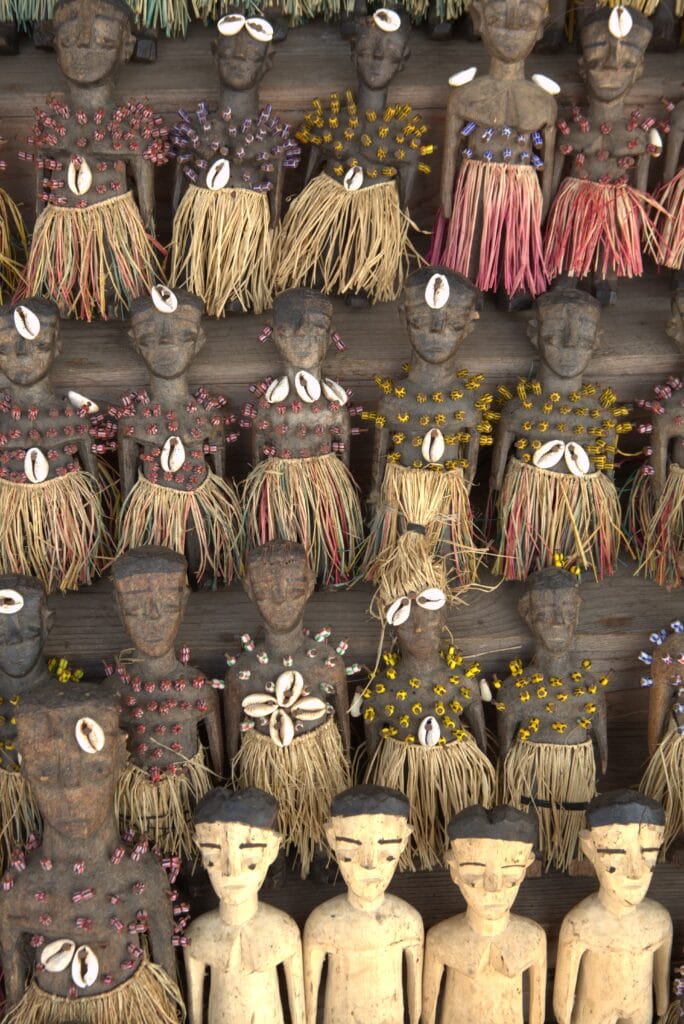
- The Akodesséwa market in Lomé — the largest supply market for Vodun practice in West Africa. It is a pharmacy and a workshop, not a show. Photography is charged and negotiated; we arrange it beforehand.
- Zangbeto on the coast — the night guardians of the Gen and Ouéi, who come out at Aného and in the villages between Lomé and the Beninese border. We write about how to read them in Zangbeto at dusk.
- Convent ceremonies in Ouéi and Gen country — initiations, outings of the newly initiated, annual renewals of the shrines. These are not scheduled events; they are announced within a lineage a few days ahead. Being there depends on knowing someone, which is the whole of our work.
Which is why we say plainly: in Togo you do not attend a Vodun festival. You are received, or you are not.
How we handle the request
Most people who ask about a Togo voodoo festival end up travelling in one of two ways.
The first is September, built around Epé-Ekpé at Glidji, with Aného, Togoville and the Lomé coast around it. The second, and more common, is January: Vodun Days at Ouidah in Benin, with three or four days in Togo before or after it — Akodesséwa, the lagoon country, the convents. That is what our seven-day Benin and Togo journey does, and the border crossing takes an afternoon.
If you want to see the practice rather than the programme, come outside both. There is no season in which Vodun is not being practised in southern Togo.
Ask us what is actually happening on your dates
We are based in Cotonou, three hours from Aného. We check the Togolese calendar with the lineages, not with a website — and we will tell you when there is nothing to see.
Go further