
Field Notes · Vodun heritage · 10 min read
Zangbeto at dusk — a photographer’s notebook from Porto-Novo
The Zangbeto come out at dusk on the esplanade of the French Fort. The light is golden, the camera is in your hand, and the question is what to do with both.
By Fèmi · Porto-Novo, July 2024 (notes)
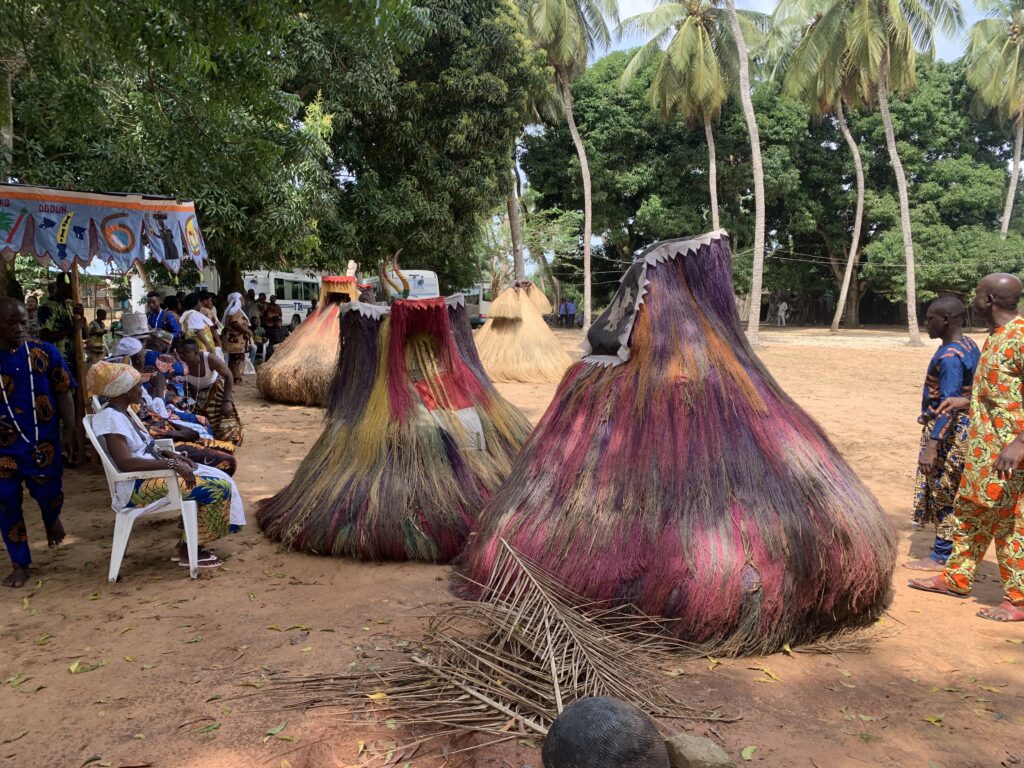
The first Zangbeto demonstration I tried to photograph was at the 2024 edition of the festival, on the esplanade of the French Fort in Porto-Novo. It was around six in the evening, the light had that particular West African quality where the sky is still pale but the colours on the ground are intensified — the red of the fort’s walls, the bright cloths of the spectators, the conical raffia structures of the Zangbeto themselves catching the last direct light. I lifted the camera. A steward looked at me. I lowered the camera. He nodded once. That nod taught me the photography of the festival.
What the Zangbeto are
Zangbeto — literally "guardians of the night" in the Fon language — is a religious-civic institution specific to the Goun and Fon peoples of the coastal region of Benin and southern Togo. Where Egungun is Yoruba-Nago and reaches toward ancestors, Zangbeto is Goun-Fon and reaches toward a different cosmological register: the masks are not embodied ancestors but autonomous spirit beings, conceived as belonging to the night and to the underworld of the living community. Their traditional function is patrol — they keep the night safe, identify wrongdoing, protect against witchcraft.
In the Goun-Fon villages where Zangbeto is most active, the masks emerge at certain hours of the night and at certain ritual moments. They are not for entertainment. The conical structure — typically three to four feet tall, made of woven raffia, covered with brightly coloured cloth — is the spirit’s body. The drummer leads the rhythm. The Zangbeto spins.
A signature element of the Zangbeto demonstration is the lift. At the height of the performance, the mask is briefly lifted off the ground to show what is underneath: nothing. No human, no support, no mechanism. The space is empty. The demonstration is a cosmological assertion: the spirit moves itself.
The light at the French Fort
The Porto-Novo Mask Festival places its Zangbeto demonstrations on the esplanade of the French Fort — the colonial bastion that overlooks the lagoon, built in the seventeenth century to administer the trade of the Bight of Benin. The choice of site is, every July, an act of reoccupation. The stones that watched the deportation now watch the spinning of the spirit. The light on the esplanade at dusk is the most photographable light of the festival.
For a photographer, the technical conditions are ideal in the worst way. The golden hour is exactly when the demonstrations begin; the raffia of the Zangbeto catches the diagonal sun; the colours of the cloth are saturated; the crowd makes a beautifully composed background. Everything in the visual frame asks to be photographed. This is precisely the trap.
When to lower the camera
The Zangbeto demonstrations have specific moments where the photography protocol is relaxed and specific moments where it is not. The relaxed moments: the procession arriving on the esplanade, the early spinning, the drum sequences, the wide shots of the masks against the fort. The crowd in the background is welcome — even the foreign visitors with cameras become part of the scene.
The non-relaxed moments are the lift sequences. When the steward signals that the mask will be lifted to show the emptiness underneath, the cameras go down. The cosmological assertion the demonstration is making is fragile to image-capture: photographing the lift and analysing the photograph after is, in the practitioners’ reading, a category error. The lift is not a magic trick to be debunked. It is the moment the spirit reveals itself by showing that no human is doing the work.
"The Zangbeto lift is not the moment to take a picture. It is the moment the picture would never have captured anyway."
After dusk
The Zangbeto demonstrations typically continue until around seven or seven-thirty in the evening — past sunset, into the actual night. The light gets harder for photography but more atmospheric for memory. The drumming continues. The masks move in patterns that, in the half-light, can be hard to fix in the eye. This is, for many visitors, the most powerful moment of the festival’s first day: the moment when the traditions stop being subjects for the camera and start being a presence one is simply standing in.
A photographer’s notebook is supposed to be a list of what to shoot. This notebook ends with what not to shoot, and why. The Zangbeto are not concealing themselves from the camera because they are mysterious. They are concealing themselves because the cosmology they hold cannot be flattened into an image. The protocol is the practice. The photography you do not take is, in this case, the photography that respects the demonstration for what it is.
Continue reading
This article is part of our topic cluster around the Porto-Novo Mask Festival cornerstone. Related Field Notes : Reading Egungun without an initiation · Guèlèdè at UNESCO.
Sources and further reading : Suzanne Preston Blier, African Vodun : Art, Psychology, and Power (University of Chicago Press, 1995), chapter on Zangbeto ; Benin Tours guidelines on festival photography (2024-2025 editions).