
By Fèmi (Oluwafemi Kochoni) · Founder & field producer · Cotonou, Benin · Updated 8 September 2026 · Permit file confirmed with the ADAC on 7 September 2026
What a production needs to know before it books flights to Benin: who issues the permit, how long it really takes, what the drone rules are, when the light is good and when the roads are not. Written from Cotonou, and re-checked with the agency that signs the permit rather than copied from another guide.
The filming permit
Filming permits in Benin are issued by the ADAC, the Agence de Développement des Arts et de la Culture, created by decree n° 2024-899 of 17 April 2024, which absorbed the former Direction de la cinématographie. There is no online portal: the file is lodged on paper, in Cotonou. We asked the agency directly what it requires. As of September 2026 the file is:
- A handwritten request for filming authorisation — handwritten, not typed. Yes, still.
- The synopsis of the film, in French. An English synopsis will be sent back; we translate it.
- The list of filming equipment.
- The number and identity of the crew — names, passport details.
- Locations, dates and duration of the shoot.
- A receipt for the official fee of 20,000 CFA francs (about €30), paid into the Direction de la cinématographie account at the Public Treasury. We give you the account details with the file; the fee is paid locally, in person.
- A written undertaking to deposit a copy of the finished film, on a video medium, with the CNCIA — the national cinema and moving-image centre — once it is completed.
Two things worth noticing. The official fee is a fraction of what most foreign guides quote — the two-hundred-dollar figures you will read elsewhere are someone’s service charge, not the state’s. And the deposit obligation is real: Benin wants a copy of what is filmed on its territory, and a production that forgets it will find its next permit harder to obtain.
Processing time: 72 hours from a complete file, as confirmed by the ADAC on 7 September 2026. Not the four to eight weeks that foreign guides quote — those figures date from before the agency existed, or count the time their own intermediaries take. The condition is the word complete: a missing passport copy or an English-only synopsis restarts the clock. What still takes weeks is everything around the permit — drone authorisation, festival accreditation, the ATA carnet, and ritual access — which is why we ask you to write the day the project is greenlit.
What the permit does not cover. Ritual access. A national permit lets you film in the country; it does not let you film inside a convent or a ceremony. That is a separate conversation with the lineages, described in Filming Vodun in Benin. Festival accreditation and drone flights are separate too, below.
Drones
Drone flights are authorised by the civil aviation authority (ANAC) and can be folded into the permit application if declared at the outset. Add them afterwards and you restart the clock. Over festival sites — Vodun Days at Ouidah, the Porto-Novo Mask Festival — the organisers impose their own perimeter on top of ANAC’s, and six weeks is the minimum to have both.
Equipment and customs
Bring your kit under an ATA carnet; allow three to four weeks to obtain it in your own country. Without a carnet, customs at Cotonou airport will want a deposit against the declared value, and you will spend your first shooting day at the airport. Hire locally what you can: vehicles, lighting, sound, a licensed drone operator. Cameras and lenses you bring.
Visas
Benin issues an e-visa online in one to two days, up to about two hundred dollars depending on duration and entries. Crew members should apply individually; a filming permit is not a visa and does not replace one. Yellow fever vaccination is checked on arrival.
Money and incentives
There is no tax incentive or rebate for foreign productions in Benin. The currency is the CFA franc (XOF), pegged to the euro; cards work in Cotonou hotels and little else. Budget for cash, and for a fixer who carries it safely. Our own terms are simple: forty per cent on commission, balance within fifteen days of wrap.
When to come
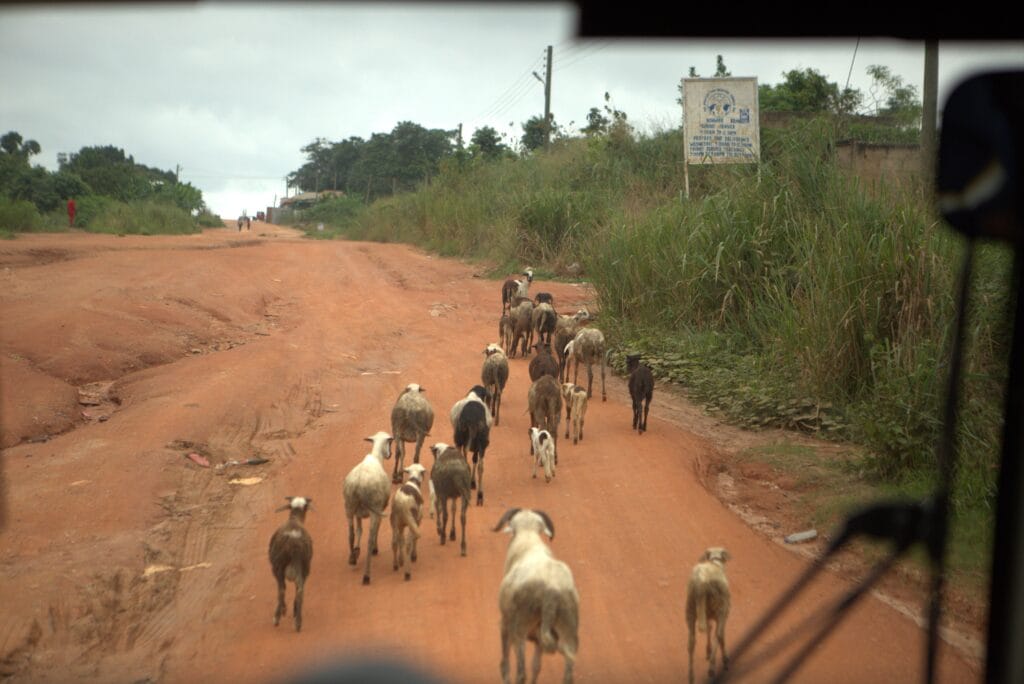
November to February is the season: dry, the light clean, the harmattan haze arriving from late December and softening everything — a gift for some films, a problem for others. March to May is hot and the first rains come; June to July is the long rainy season, when laterite roads in the interior become a schedule risk; a short dry window opens in August; September to October brings the second rains.
The one fixed date that matters: Vodun Days at Ouidah, 2–9 January 2027, the only week in the year when Vodun is on a public stage with a programme. Everything else in the ritual calendar is decided by the lineages and announced days ahead.
Where
Ouidah — the Slave Route and the Door of No Return, the Python Temple, the sacred forest of Kpassè, the beach. Abomey — the royal palaces, a UNESCO site with its own filming rules. Porto-Novo — the Afro-Brazilian quarter, the great mosque, the Egungun and Zangbeto. Ganvié — the lake village, by boat only, best at first light. Grand-Popo and the Mono — lagoon, coconut coast, the Vodun country of the south-west. Dassa and the Collines — inselbergs, granite, the pilgrimage site. Cotonou — Dantokpa market, the Amazon statue, the port.
The north. The Atacora, the Pendjari park and the Burkina and Niger borders are under a formal travel warning. We do not take crews there and we do not know a serious fixer who does. If a story needs the north, the conversation starts with a security assessment, not a schedule.
On the ground
Languages. French is the working language; Fon in the south, Yoruba and Goun around Porto-Novo, Mina on the coast towards Togo. English is rare outside hotels — your fixer is your interpreter.
Power and connectivity. Cotonou is reliable; the interior is not. Bring batteries and a generator plan. Mobile data is good on the coast and thin inland.
Roads and time. Cotonou–Ouidah, one hour. Cotonou–Abomey, two and a half. Cotonou–Grand-Popo, two. Cotonou–Lomé, three including the border. Double every figure in the rainy season and on market days.
Faces. People here are photographed for a living by tourists and rarely asked. Ask. In ritual settings, consent is collective and comes through the lineage, not from the individual in front of the lens — which is the whole subject of the next page.
What a fixer costs here, and what you get
You will find day rates in Cotonou from sixty dollars. What that buys is a driver who speaks French. What we sell is different and priced differently: a written rate card at first contact, three units depending on the work, and two lines that are never marked up — the counter-gift to the lineages and the honoraria of the scholars. Who we are and how we work is on Fixer in Benin.
Build your schedule on confirmed figures
Tell us your window and what you need to film. We confirm the permit lead time with the ADAC for your dates and come back within 48 hours with a rate card and a first answer.
Go further