
By Fèmi (Oluwafemi Kochoni) · Founder & field producer · Cotonou, Benin · Updated 8 September 2026
Every producer who writes to us about Vodun asks the same two questions: what can we film, and how do we get permission. Here is the honest answer to both, including the part most guides leave out — that the answer is sometimes no, and that a fixer who never says no is not getting you real access.
Start by dropping one word
You will search for “voodoo” because that is the word your audience knows. On the ground, say Vodun. It is the name of the religion, of its deities, and of the thing you are asking to enter. Using it is the first signal to a priest that you have done some reading, and the difference between a conversation and a polite refusal. On this site we keep “voodoo” only where searchers need it.
Three circles
Think of Vodun as three concentric circles, each with its own rule.
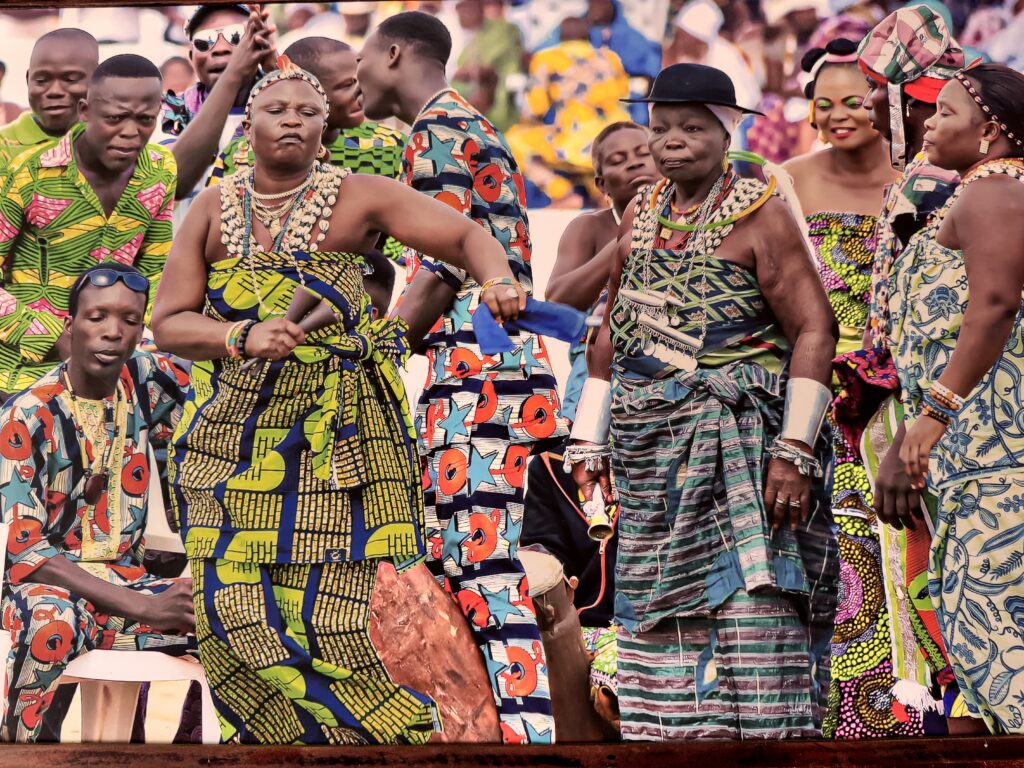
The public circle. Festivals, processions, the outings of Egungun and Zangbeto in the street, the annual festival at Ouidah. Filmable with a permit and accreditation, within the perimeter the organisers set. This is where nearly all existing footage of Vodun was shot, which is why it all looks the same. Vodun Days, 2–9 January 2027, is the one week in the year when this circle has a programme and a stage.
The lineage circle. Ceremonies held by a family or a convent for its own deities: annual renewals, outings of the newly initiated, funerals of dignitaries, consultations of Fa. Not public, not scheduled in any calendar you can find, announced within the lineage a few days ahead. Filmable sometimes, on the lineage’s terms, after a request made in the right way by someone they know.
The inner circle. The interior of the convent during initiation, certain moments of possession, the objects themselves, the words spoken to the deities. Not filmable. Not for money, not for a foundation, not for a famous director. Every year a production arrives convinced it will be the exception. It is not, and the attempt costs everyone who comes after.
How permission is asked
You do not ask the priest. You ask someone who can ask the priest, and that person has to be known to the lineage before your project exists. This is not obstruction; it is how a religion without a central authority protects itself. There is no bishop to write to.
The request goes up through the family: what the film is, who is making it, where it will be shown, what will be filmed and what will not. The elders consult. They may want to meet you first. They may say yes to the ceremony and no to the convent. They may say yes and change their minds on the day, because a sign was read that morning. All of this is normal, and a schedule that cannot absorb it is a schedule for a different film.
We make these requests through family standing within the lineages of the south, which is the only way they can be made. We do not sell access; we ask for it and transmit the answer, including when the answer is no.
The counter-gift
A ceremony opened to a camera has a cost for the family: animals, drink, cloth, the dignitaries’ time, sometimes a rite to close what was opened. The counter-gift covers it. It is not a fee for access and it is not negotiated like one; it is set by what the ceremony requires, and it goes to the family, not to an intermediary.
On our invoice it appears as a separate line, at cost, itemised, with no margin. You see exactly what reached the community. We do this because it is right, and because a producer who can show that line to a commissioning editor is a producer who gets the next film funded.
What may not be filmed, in practice
- The interior of a convent during initiation, and the initiates during seclusion.
- Certain moments of possession, at the priest’s discretion, decided on the spot. When the camera is asked to lower, it lowers.
- The sacred objects — what is kept, what is fed, what is carried — unless explicitly shown to you.
- Faces of initiates without the lineage’s consent. Consent here is collective, given by the elders on behalf of the family, and it can be withdrawn.
- Egungun at close range. The masqueraders are the returned dead; there are rules about distance and about who may touch, and a cameraman who crosses them is not protected by his accreditation.
- Zangbeto at night in the villages, unless the guardian society has been approached.
- Anything the lineage has said no to, even if a different lineage said yes to the same thing last year.
The charter
Before any lineage access we sign one page with the production: what will be filmed and what will not, who gives consent and how it may be withdrawn, what the counter-gift covers, and a right of withdrawal on both sides if the framing changes. We ask for a copy of the finished film — not for approval, which we do not have and do not want, but so that the families who opened their doors can see what came of it. Almost no foreign production does this unasked. Here it matters more than the fee.
What we turn down
Projects whose framing needs Vodun to be frightening: possession as horror, sacrifice as gore, the priest as a witch doctor, the convent as a curiosity. We decline them in writing, and we would rather lose the contract than the access. If your editorial line needs that, there are operators who will take the job; we are not one of them. If your line needs the opposite — a religion seen from inside, with time — we can probably open more than you expected.
What a good Vodun film needs
Time, first. A ceremony that has been asked for properly happens when the lineage is ready, not when the crew is. Build slack into the schedule or build the film around the public circle. Second, a director who will sit through an hour of nothing happening, because that is where the trust is built. Third, a fixer who is inside the conversation rather than translating it from the door. And fourth, a willingness to hear no, and to come back.
Tell us what you want to film
Send the synopsis and your window. We will tell you within 48 hours which circle it falls in, what can be asked, and what it will cost — including what will go to the families.
Go further