
The Slave Route of Ouidah — walking memory on the Bight of Benin coast, from the Auction Square to the Door of No Return
This is not a tour. It is a four-kilometre walk through what the Atlantic trade did to a coast and to the people it took from it. Ten stops, two centuries, one million names that no longer have addresses. Before we descend toward the Door of No Return, there is one thing to settle: the Slave Route at Ouidah does not belong to memory in general. It belongs to the kingdoms that organized it, the captives that walked it, and the descendants who walk it again.
Why walk the Slave Route at Ouidah
The Slave Route at Ouidah is a four-kilometre memorial walk in southern Benin that traces, across ten stations, the route imposed between 1670 and 1860 on more than one million people deported from this coast to the plantations of the Americas. You understand the trade here not through a museum vitrine but under your own feet — on an ochre paving that imitates the original laterite and ends at the Door of No Return, facing the Atlantic. Ouidah is not an ordinary travel destination. It is not a beach you photograph or a site you tick off. It is a place where the history is still walking.
The past is not behind glass. It is in the air, in the trees, in the faces of the people who live every day among the monuments of one of the largest crimes of the modern world. Saidiya Hartman’s phrase for this is the afterlife of slavery — the way the trade did not end when the ships stopped, but became weather, institution, body. Ouidah is one of the places where that weather can be walked.
“The first time I walked an African-American family group along this route, a woman stopped at the Tree of Forgetting and did not move for twenty minutes. She told me afterwards: ‘My great-great-grandfather walked around this tree. I came to finish a circle.’ That was when I understood: this is not a tour. It is a pilgrimage made by people whose ancestors walked it without choice.” — Laurence, memorial guide at Ouidah, partner of Heritage and Routes
This guide was written to help you prepare that walk — logistically, but also editorially. It draws on years of field work, on time spent with Professor Honorat Aguessy at the Institut de Développement et d’Échanges Endogènes (IDEE) in Ouidah, on close reading of the historians who have studied the trade — I. A. Akinjogbin, Dahomey and its Neighbours, 1708-1818 (Cambridge, 1967); Robin Law, Ouidah: The Social History of a West African Slaving ‘Port’, 1727-1892 (Ohio UP, 2004); Edna G. Bay, Wives of the Leopard (Virginia, 1998); Patrick Manning, Slavery, Colonialism and Economic Growth in Dahomey (Cambridge, 1982); the African-diaspora intellectual tradition that begins with Du Bois and runs through Saidiya Hartman, Stephanie Smallwood, Marcus Rediker, Paul Gilroy — and on the returns of hundreds of travellers we have accompanied across Benin, Togo, Ghana, Senegal, Nigeria and Côte d’Ivoire.
Ouidah in numbers — measuring what words struggle to say
Some places resist superlatives. Numbers, by contrast, sometimes speak with a precision that prose cannot reach.
Across two centuries of continuous activity (1670-1860), more than one million people were embarked from this town on the Beninese coast for the plantations of the Americas, the Caribbean and Brazil. Ouidah accounted for 51% of all exportations from the Bight of Benin — the Slave Coast as European traders called it — and stands, alongside Luanda, as one of the two most active embarkation ports in the entire history of the Atlantic trade, ahead of Cape Coast, Elmina and Lagos.
| Datum | Figure | Context |
|---|---|---|
| People deported | 1 million + | Across two centuries of activity (1670-1860) |
| Share of the Bight of Benin | 51 % | More than half of the region’s exports |
| Duration of activity | ≈ 200 years | From the reign of the Dahomean kings to effective abolition |
| Length of the memorial route | 4 km | From the Auction Square to the Door of No Return |
Source: Slave Voyages Database (Emory University), the global reference database on the transatlantic trade.
One detail deserves its own paragraph: the word “port” is, strictly speaking, inaccurate. Ouidah is four kilometres inland, without a sheltered harbour, and the ships rode at anchor offshore. These four kilometres are not a commemorative ornament. They are the actual route imposed on more than one million people to reach the sea.
The numbers also reveal a brutal ramp inside a single decade. Akinjogbin documents the jump: before 1671, an estimated 3,000 per year were deported from the whole Aja country. By the 1680s, Great Popo alone could fill a ship within days, Whydah was exporting about 12,000 captives a year, and Allada was raising its own quota — close to 20,000 a year across the coast (Akinjogbin, p. 34). The pace had been multiplied by seven in fifteen years. A century later, at the system’s peak, King Tegbessou’s annual income from the export of captives through Ouidah was estimated, around 1750, at between £216,000 and £288,000 per year for French and Portuguese ships alone (Akinjogbin, p. 134, after Guestard, director of the French fort). It was one of the largest monarchical revenue streams in eighteenth-century West Africa.
How Ouidah became the largest slaving port in West Africa
To walk this Route with any depth, you need to understand why Ouidah — and not Cape Coast in Ghana, with its fortified castles — is, alongside Luanda, what Law calls “the second largest embarkation point in the entire Atlantic system” (Law, p. 1).
An African system, not a European conquest
Where Europeans had to build forts on the Gold Coast against reluctant kingdoms, the kings of Dahomey actively organised and monopolised the trade. The power was not European. It was African. Ouidah, moreover, is not a port: with no sheltered bay, ships rode at anchor offshore in dangerous surf, and captives were embarked by canoes worked by paddlers brought up from Elmina or Cape Coast, since the lagoon-side residents did not know how to handle the open Atlantic (Law, pp. 29, 39-40). That geography shaped everything: who held leverage, how long captives waited, how many died on land, the very geometry of the Route.
One precision of dating clarifies the architecture. The royal monopoly was not declared in one stroke. Agadja, the conqueror of Ouidah, accepted the trade as a state axis only in August 1730, under joint pressure from the Oyo Empire (in present-day Nigeria) and the European factory directors. He never liked it. “He had lived too long to change his repugnance for this trade,” Akinjogbin summarises (p. 208). The complete monopoly was consolidated only after 1745, by Agadja’s son Tegbessou, who simply executed the private traders (p. 127).
The European role, for its part, was never merely commercial. “Throughout the eighteenth century, European governments seem to have agreed to prevent any useful information from reaching African hands,” writes Akinjogbin. “None of the Dahomean embassies to Portugal succeeded. When Tegbessou asked for a French education for his heir in 1751, it was refused. When Adandozan sent two princes to study in England in 1801, they were sold as slaves instead” (Akinjogbin, pp. 210-211). The system was African in its organization, but it was always caught inside the rapacity of Atlantic commerce.
Before 1727 — the Hueda kingdom
Before there was Ouidah, there was Savi, capital of the Hueda kingdom — the one Europe rendered in half a dozen spellings: Whydah, Juda, Ajuda, Widah, Oueda, Fida (Akinjogbin, Annex I, p. 213). One kingdom, six orthographies, all the same place. The Savi site, eleven kilometres north, was excavated in the 1990s by Kenneth Kelly (UCLA).
Before the Hueda kingdom, there was a system. Akinjogbin showed that the Aja kingdoms — Allada, Hueda, Popo (modern Grand Popo in Benin and Petit Popo, also called Anécho, in Togo), Jakin (on the site of present-day Godomey) — were not isolated states. They formed a confederation he called Ebi, from the Fon-Yoruba word for “family” (Akinjogbin, p. 16). Allada, founded around 1575, was the “father-kingdom”; the others owed it ritual deference inscribed in genealogy and confirmed at coronations. There was no federal army and no central police. Allegiance rested on respect for the bond, not on force. This architecture, slow to defend itself, was exactly what the Atlantic trade dislocated between 1670 and 1727 — and what Agadja’s conquest finished off.
Agadja’s assault on Savi — the royal Hueda capital — took place on 26 February 1727. In five days, the Dahomean army took most of King Houffon’s kingdom: more than 5,000 Hueda killed, 10,000 to 11,000 taken prisoner, and the European factories at Savi looted — the English factory alone lost about £2,500 in goods (Akinjogbin, p. 71, citing the Accounts and Journals for Whydah, T 70/598, Public Record Office, London). Houffon escaped in a hammock to an island near Grand Popo; his descendants maintained a government in exile around Lake Ahémé — the Hueda-Hendji — for more than a century (Law, ch. 2).
From Yovogan to Chacha
For Ouidah to become the single port, it took a political decision in August 1730. Three years after the fall of Savi, on 12 May 1730, John Brathwaite, one of the three directors-in-chief of Cape Coast Castle, landed at Igelefe (the Dahomean name for Ouidah) with a precise mandate: settle the quarrel between Agadja and the surviving Hueda in the interest of the slave trade. The compromise, struck in August, was striking. Agadja agreed to concentrate all European trade at Ouidah and to close the rival port of Jakin. On 25 August 1730, the English factory at Jakin began evacuating; on 22 August, Director Deane left Allada escorted by Dahomean troops. The agreement was celebrated with sixty-three cannon salvoes — twenty-one each for the kings of England, France and Portugal — and £18 of liquor distributed by the English factory alone (Akinjogbin, pp. 92-95). “For the Europeans,” comments the historian, “the occasion warranted this jubilation: Agadja had finally converted to the slave trade” (p. 95). That is why Ouidah, and not Jakin, became the port.
Three years later, in January 1733, King Tegbessou created the office that would do the daily work: the Yovogan, literally “chief of the whites,” resident at Fonsaramé. He held the interface with European merchants — authorised access to the forts, set the taxes, negotiated the contracts (Law, p. 12). His first holder was a man named Tegan (Akinjogbin, p. 102). Before him, three officers had shared the work — one per European nation — but the directors found the hospitality cost too high. Tegbessou ruled: one Yovogan.
The post was not a sinecure. Of the nine first holders appointed between 1733 and 1763, five were decapitated — three between April and November 1755, one in 1760 after only twenty days in office (Akinjogbin, p. 120). The charges most often rested on allegations passed by the European directors. Tegan himself was executed on 27 July 1743, fourteen hours after being arrested at Allada, where he had been invited to celebrate the destruction of the Portuguese fort with the king; his property was seized on the spot. The French director Levet, who hated him, had denounced him to the king seven days earlier (Akinjogbin, p. 119, citing Levet to the Compagnie des Indes, Archives nationales, C. 6/25). Between 1743 and 1763, a Yovogan was, statistically, more likely to be beheaded than to die in his bed. King Tegbessou himself summed up the policy in a message sent in November 1754 to the English director Devaynes: “it was better to trade than to make war” (Akinjogbin, p. 127).
But Ouidah does not manufacture its captives — it receives them. Akinjogbin shows that from Tegbessou onward, the captive supply came less from Dahomean raids than from the merchants of the Oyo Empire, the Yoruba state to the north-east, to which Dahomey became tributary in 1748. The captives sold at Ouidah were classified by origin — Fon, Hueda, Allada (“all Aja”) and Nago (Yoruba); the Portuguese bought the Aja but not the Yoruba; the French took the rest (Akinjogbin, p. 134). Around 1750, about 9,000 captives a year left Ouidah on French and Portuguese ships alone. It is the collapse of this Yoruba pipeline, after the suicide of Alafin Awolé around 1796 and the disintegration of the Oyo Empire, that would plunge Ouidah into a long depression at the end of the eighteenth century.
In 1818, the Afro-Brazilian Francisco Félix de Souza, born in Salvador da Bahia, helped engineer the coup that placed Prince Gakpe — the future King Guézo — on the throne. As reward, he became commercial agent for Guézo at Ouidah, with right of first refusal on the palace captives. He founded the Brazil quarter (Blézin) and built a transatlantic network oriented toward Bahia. His nickname “Chacha” — from the Fon chacha, “quickly” — became a dynastic title only after his death, passing to his sons Isidoro, “Chico,” Juliao and Lino (Law, p. 167).
The slave trade of Ouidah is not a story of invaders and passive victims. It is a story of a system — African and European — in a complicity that the Route now holds with a rare lucidity.
A kingdom founded against the trade
Before it became the largest supplier of captives on the coast, the Kingdom of Dahomey was, at its founding, designed to protect itself from the trade.
Around 1620, at Allada, a succession crisis followed the death of King Kokpon. Prince Dako was elected and deposed. He took a hundred partisans and moved north, to the Igédé plateau, where he founded Abomey. This was not a dynastic detail. It was, as Akinjogbin puts it, “the first serious counter-blow to the traditional political organisation of the Aja” (p. 21). Dako rejected the Ebi system because he had seen it fail under the trade.
His political answer was radical. The Dahomean constitution — as transmitted by King Guézo and confirmed in 1962 by Pierre Verger, P. Mercier and Prince Justin Aho (Akinjogbin, p. 25) — rests on a symbol: the state is a cracked pot, the king is the water that must remain inside, the subjects are the fingers that plug the cracks. Citizenship by service, not by blood. Authority by force, not by descent. “In a dry plain like the Abomey plateau, water was scarce and precious; far less ubiquitous than fathers” (Akinjogbin, p. 25). A state designed against the genealogical uncertainty that made Allada fragile.
And opposed, explicitly, to the trade. Before Agadja, the Kingdom of Dahomey is documented twice as having blocked Allada’s slaving raids — in 1670-71 (reported by Barbot) and in 1687-88 (reported by Roussier). Each time, the slavers came back empty-handed (Akinjogbin, p. 24). The English traveller William Smith, writing in 1744, transmitted the Aja word: “the discerning natives account it their greatest unhappiness that they were ever visited by the Europeans. They say that we Christians introduced the traffick of slaves” (cited Akinjogbin, p. 18).
The shift comes with the founder’s grandson. When Agadja takes Ouidah on 26 February 1727, he still thinks he might substitute another trade — he discusses with his English captive Bulfinch Lambe the idea of plantations and European craftsmen “other than slave merchants” (Akinjogbin, p. 77). But the four invasions of Oyo (14 April 1726; 22 March 1728; March 1729; January 1730) cost him his capital Abomey four times. In August 1730, exhausted, he signs the agreement with Brathwaite that turns Ouidah into the single port — and that turns Dahomey against its own founding.
It exonerates no one. It explains. And it is also what makes the Route, walked today, more complex than a story of victims and aggressors. Saidiya Hartman’s argument in Lose Your Mother (2007) sits here precisely: the descendants of slavery cannot make a homecoming of West Africa as if Africa were innocent. The kingdoms that organised the trade were African, and the bodies they sold were African, and the question of how to hold that fact has been Black memory work for two centuries.
After 1860 — what the Route keeps telling
Before telling the end, one needs to understand how the system ran down. De Souza’s arrival in 1818 is not a stroke of individual luck — it is the outcome of a fifty-year depression. From 1767, Ouidah’s trade slipped: the American Revolution, the French Revolution, the British abolition of 1807 — each international shock lowered the number of ships (Akinjogbin, ch. 5-6). The Portuguese director himself wrote in 1788 that there were not enough captives “even for Portuguese ships alone” (Akinjogbin, p. 142). This depression, fifty-one years with no improvement, produced the murder of King Agonglo in 1797 and the deposition of Adandozan in 1818 (Akinjogbin, Conclusion, pp. 208-212). It is in this climate — a weakened kingdom, a contested dynasty, an economy in crisis — that the coup placing Gakpe (the future Guézo) on the throne succeeded, and that an Afro-Brazilian like Francisco Félix de Souza, a decisive ally in the coup, obtained an unprecedented commercial monopoly as reward. The Chacha was not born into a strong kingdom. He profited from a sick one.
After 1818, the slave activity at Ouidah does not stop sharply with abolition. It overlaps, for nearly twenty years, with the new economy of palm oil exported to Marseille and Hamburg.
The pivot 1840-1860 — same families, different commodity
British abolition was gradual. At Ouidah, the same warehouses, the same ships, the same families — de Souza, dos Santos, Martins — moved from the illegal trade to palm oil. In 1846, Domingos José Martins dos Santos symbolically shipped ten pipes of oil to Bahia: four tonnes, almost nothing in volume, but a signal (Law, p. 204).
Juliao de Souza and the end of the Chacha dynasty (1885-1887)
The fourth Chacha tried to secure a Portuguese protectorate. Glèlè denounced the treaty in 1887; Juliao died in prison the same year (Law, pp. 266-268). The French bombardments of 1890 and 1892 preceded the definitive conquest.
Ouidah today
The Route was formally laid out for “Ouidah ‘92.” Since 1998, the town has held a public ceremony of repentance (Law, p. 15) — a living commemoration, conducted by the inhabitants themselves for thirty years.
Three and a half centuries at a glanceFrom the founding of Abomey to the laying out of the memorial Route — 1620 to 1992
The ten stations — what you see and what you carry away
The walk unfolds in ten stations, in two movements. Three in town, east to west, to lay the spiritual and historical groundwork. Then seven north to south, along the four kilometres of the Route proper — now paved in ochre to recall the original laterite and accessible, wheelchair included, all the way to the Door of No Return. You enter Ouidah through its roots, before you descend toward the sea.
Station 1 — The Sacred Forest of Kpassè: the spiritual root of Ouidah
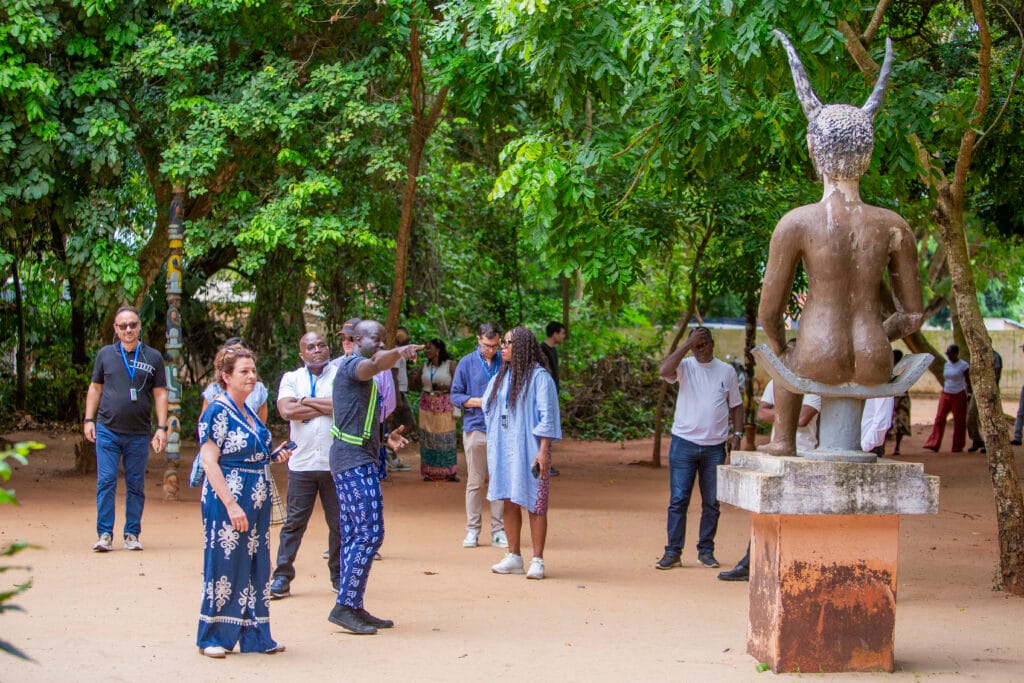
You begin at the origin. The Sacred Forest of Kpassè holds the living memory of King Kpassè, second king of Savi and founder of the Hueda city. Oral tradition tells that in the seventeenth century, in the evening of his life, Kpassè vanished into this forest and incarnated himself in an iroko tree that now bears his name, Kpassèloko. The tree, wrapped in white cloth, remains the ritual heart of the site: every new king of Ouidah, on his enthronement, comes here to commune with the founder’s spirit.
Akinjogbin documents that the great royal annual feast of Allada — the So Anoubomey, three months during which no military expedition could be launched — is attested as early as December 1717 (p. 64). The Dahomean Hwetanou, and now the Vodun Days that fill Ouidah every January, sit inside this long continuity. Three centuries of unchanged ritual gesture. You are walking on ground where memory has never stopped being active.
Once spread over thirty hectares, the forest today covers four at the centre of town. Since “Ouidah ‘92,” it has been open to non-initiates and holds, in the open air, the monumental statues of the principal Vodun deities — Tolègba, Hêviosso, Dan, Gou, Sakpata. To begin the visit here is to enter Ouidah through its pre-Dahomean stratum: before the trade, there was Kpassè.
Station 2 — The History Museum / Fort São João Baptista de Ajudá
Housed in the Portuguese fort built in 1721, the Museum offers a chronological, documented reading of the trade — essential for setting the figures, the maps, and the objects before walking down to the sea. The only sheltered site on the route. A rare detail: of the three European forts at Ouidah (the French and English forts having vanished), this one remained occupied until 1961 — a Portuguese garrison still defended it a year after Dahomean independence. Allow 45 minutes.
Station 3 — The Temple of Pythons: Dangbé, the royal python
On Agoli Square, facing the Basilica of the Immaculate Conception, stands the Temple of Pythons — Dangbé Houé. This is the sanctuary of the royal python Dangbé, a major deity of the Hueda kingdom, attested at Ouidah since the end of the seventeenth century. Oral tradition tells that during the war with Dahomey, the Hueda king in flight was saved by pythons that emerged from the undergrowth; in gratitude, he built three shrines for them. Historically, the conquest of 1727 transferred the sanctuary from Savi to Ouidah (Law, p. 24); when the French built the basilica at the end of the nineteenth century, they placed it a few metres from the temple. This face-to-face says, in the space itself, the whole syncretism of Ouidah.
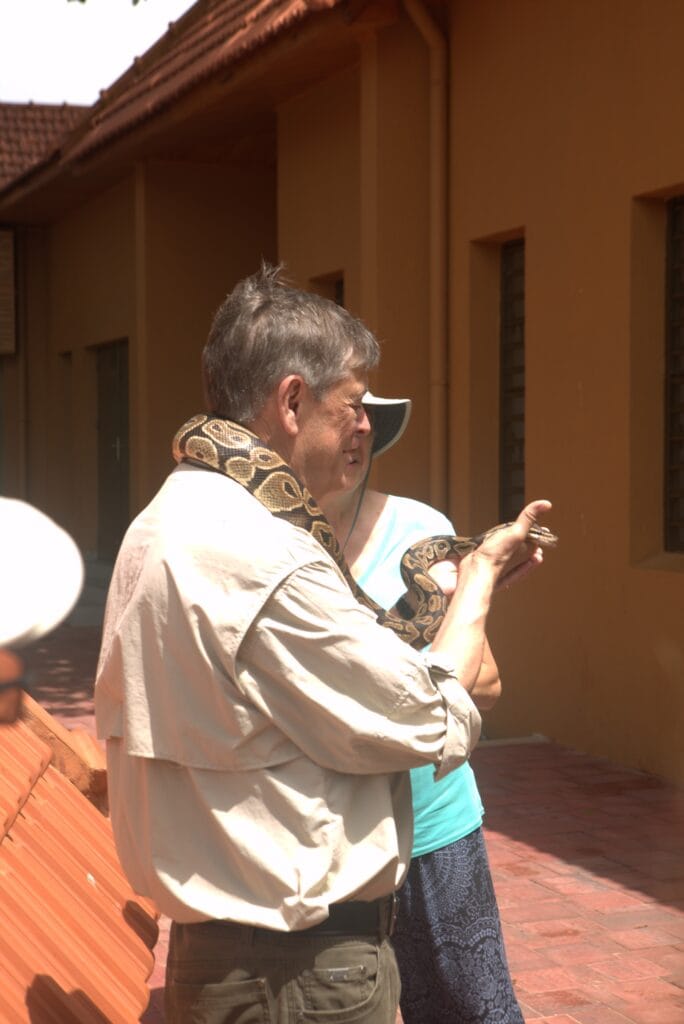
The sacred pythons live in the temple, protected and fed. If they wander into a house, the residents bring them back to the sanctuary themselves. A donation lets you pose for a photograph with a python around your shoulders — tradition holds that the contact is protective.
Station 4 — The Auction Square (formerly Chacha Square): where human beings had a price
A note up front: this name contradicts what historical documentation and oral testimony actually show. There were no auctions at Ouidah in the European sense. People were sold, people were bought; prices were negotiated, deals were made or refused. The image of a public scene staged with a crier hammering down a bid is a later construction. What the popular account now in circulation says is that here, beneath a great tree whose collapse in 2024 grieved the whole town, the public sales took place. Captives, brought in caravans from the interior, were examined, valued, sold.
Another point against the standard story: at Ouidah, trade was not chronically “slave-against-object.” The trade was monetised — captive for cash. Prices were stated in successive units of account, and Akinjogbin reconstructs the whole hierarchy: 40 cowries = 1 tockey; 5 tockies (200 cowries) = 1 gallina; 20 gallinas (4,000 cowries) = 1 cabess; 5 cabesses (20,000 cowries) = 1 once; 1 oke (sack) = 20,000 cowries (Akinjogbin, p. 124, n. 1). A porter was paid in cabess; a captive was bought in once. From the 1700s-1730s onward, the once became the dominant unit — a composite value indexed on gold and cloth, about £2 sterling. In the nineteenth century, the libra (the Spanish silver dollar) was added by the Brazilian houses (Law, ch. 4). An accounting system, not barter — this is often what most surprises visitors. The square is also the historic heart of the Afro-Brazilian quarter (Blézin), founded by de Souza from the 1820s.
Station 5 — The Tree of Forgetting: the ritual of identity erasure
Captives were forced to walk around this tree — nine times for men, seven times for women — in a ceremony of sensory and mnemonic disorientation meant to make them forget their village, their family, their identity.
A note of transparency: the current tree, like most of the material stations on the Route, was laid out for “Ouidah ‘92.” Robin Law reads the markers as “expressions of the present-day people of Ouidah’s need to reconcile themselves with their town’s slaving past” (Law, pp. 153-154). This takes nothing from the force of the ritual — it reminds us that the Route is a work of living memory. Some historians also read it as a physical disorientation meant to prevent escape; others as a Vodun spiritual dimension. The two readings sit together.
Station 6 — The Zomaï House: “where the light does not enter”
The name says everything. This was the dark, cramped shed where captives were packed before departure, to accustom them to the darkness of the hold. On the present site, a reconstruction lets you step for a few seconds into that darkness. A few seconds are enough.
This wait was not gratuitous cruelty — it was a consequence of the geography. The ships did not dock; their filling depended on arrivals and the surf. Captives could wait several weeks on land (Law, pp. 157-158). The mortality before embarkation reached terrible proportions, before the Middle Passage even began. Stephanie Smallwood’s Saltwater Slavery (Harvard, 2007) reads the Atlantic crossing as the literal making of commodities out of persons; the Zomaï House is where that making began on land.
Station 7 — The Zoungbodji Memorial: the common grave
Just after the Zomaï House comes the most silent stop on the route. The Zoungbodji Memorial is a mass grave. Here were buried the captives who died in detention — of exhaustion, illness, despair. Mortality on land reached double-digit percentages for some periods of prolonged waiting; this anonymous cemetery is the material trace.
The memorial walls bear inscribed first names, read aloud by guides at the annual commemoration ceremonies. The names are not chosen at random: they refer to the ethnic groups most intensively enslaved by the Dahomean system at Ouidah.
- Oluwafemi, Olamide, Olayinka — Yoruba names, for the Nago seized in the wars against Oyo and the Dahomean campaigns eastward (Ketu, Mèko, Igbomina).
- Mawuyon — a Fon name, a reminder that the Dahomean machine also ground up its own brothers and neighbours in the tributary raids.
- Enyonam, Kokou, Yao — Ewe or Mina names, for the captives from the western corridor (Mono, Atakpamé, Notsé, Anécho).
To read each name aloud, as the guides do each year, is to restore a precise ethnic geography: where the Dahomean system went looking for its captives.
Of all the stations on the Route, this is the one where silence is not a posture but a recognition. You do not pass Zoungbodji. You stop, and you read the names.
Station 8 — The Tree of Return: the one moment of hope on the Route
The symbolic and luminous counterpart of the Tree of Forgetting. The rare captives ransomed at the last moment by their family circled this tree to symbolically retrieve their identity. The people of Ouidah have not erased hope from the story, even when it was statistically tiny.
The image is the more apt because, for the practitioners of Haitian Vodou or Bahian Candomblé, some Vodun deities did make the return. The Haitian pantheon includes a goddess named Ezili-Freda-Dahomi, literally “Ezili of Ouidah in Dahomey” (Law, p. 2) — a ritual code-name that preserves the Ouidah address of the Azili shrine. Some of what was taken from this coast made its way back, in chants, in dance steps, in names that travelled the same Atlantic and survived.
Station 9 — The Door of No Return: facing the Atlantic
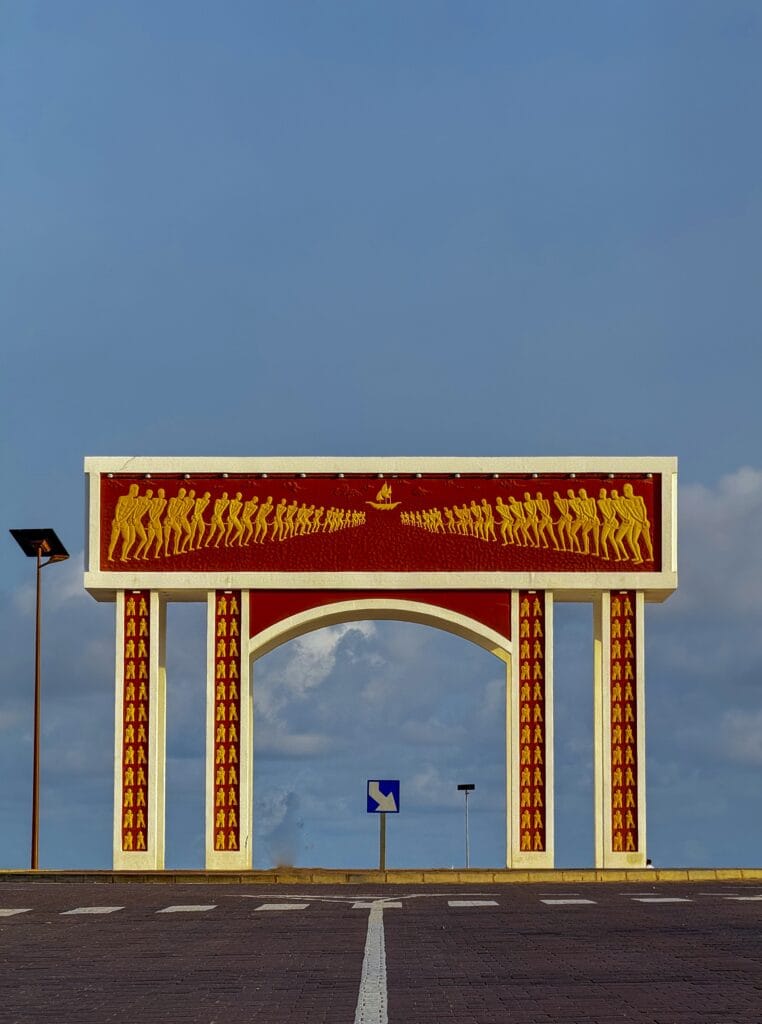
This monument, inaugurated in 1992 as part of the UNESCO Slave Route project, is a monumental arch facing the Atlantic. It is not a place that calls for contemplative silence — the sea is loud, the wind is strong, fishermen sometimes work a few metres away. That ongoing ordinary life is exactly what gives it its force. Christina Sharpe’s phrase from In the Wake (Duke, 2016) fits the moment: the ocean is “the wake” the trade left behind, and we are all still living in it. The Door at Ouidah opens onto that wake.
Station 10 — The Ship of Departure: the replica of L’Aurore
The most recent station on the Route, and now its physical and symbolic closure. The Ship of Departure is a full-scale replica of L’Aurore, a 1784 French slaver whose plans — held at the Musée de Villèle (Réunion) and the Musée de l’Histoire de l’Immigration (Paris) — were reconstructed by Jean Boudriot for Éditions Ancre. With its 280 tons, hundred feet of length by twenty-six of beam, and forty-five-man crew, L’Aurore represents the average-to-large French slaver of the late eighteenth century — exactly the type of ship that lay at anchor off Ouidah.
The force of the reconstruction is accountancy. You see, to scale, the men’s deck (400 places), separated from the women’s deck (120); the 80 children’s spaces; the holds where the return voyage carried sugar, coffee and indigo cargoes valued at 800,000 livres, for net profit approaching 300,000. For 600 captives on board, each crossing. The outbound cargo, leaving Nantes, was 19,170 “trade pieces”: Indian cloth, brandy, weapons, iron bars, copper basins — the exchange currency for the human beings stowed at the Zomaï House. Marcus Rediker’s The Slave Ship: A Human History (Penguin, 2007) reads these ships precisely: factories of commodity-making, designed to convert persons into accounting entries.
To cross this replica, after the Door of No Return, is to see materially what the sea makes vanish: the architecture of the deportation.
Browse by topic
Two cornerstones for those who prefer maps to lists
Practical information for visiting Ouidah
Getting there from Cotonou
Ouidah is 40 kilometres west of Cotonou, 45 minutes to an hour by taxi. Heritage and Routes includes the transport when you walk with us.
How much time do you need
Plan a full day for the ten stations. Sacred Forest, Museum and Python Temple in town in the morning; the Route itself and the Ship of Departure in the afternoon. Do not compress it.
When to go
Any time of year. The peak window is January, when the visit can be paired with the Vodun Days festival — a three-day public celebration (8, 9 and 10 January) that fills the town: Place Maro, the Esplanade of the French Fort, Place Ninsouxwé, the Sacred Forest of Kpassè, the beach at the Door of No Return.
What to bring
The Route is fully paved and walkable year-round. Comfortable shoes, water (one litre per person), sun cream and a hat for the open final section in the November-to-May dry season.
Should you walk with a guide
Strongly recommended. Without a guide, you see monuments. With a guide, you hear the histories the monuments do not tell on their own.
Our programmes on the Slave Route
Ouidah, one full day
The complete Slave Route (all ten stations including the replica of L’Aurore), the Sacred Forest of Kpassè, the History Museum, the Temple of Pythons, and substantive conversation with a local guide. Transport from Cotonou included.
On request, per person Departures daily · 2-person minimumSlave Coast 12-day journey
The flagship programme. Ouidah is the second day of a twelve-day arc that runs through Abomey’s royal palaces and Amazon museum, crosses the border into Togo and Ghana, and reaches Cape Coast Castle and Elmina. The geographic complement to this article: the trade was an Atlantic system, not a town.
On request, per person All accommodation and meals includedReturn — by design
For diaspora travellers building an itinerary around ancestral connection and family history. The 10-day custom programme that places your group’s questions, not our catalogue, at the centre.
Discovery call →Frequently asked questions
How does Ouidah compare to Cape Coast Castle?
The two sites are usually walked together by serious diaspora travellers, and they answer different questions. Cape Coast Castle shows the trade from the European fortified position — the slave hold below, the chapel above, the architecture of colonial commerce. Ouidah shows it from inside the African political system that organised the supply: the kings of Dahomey, the Yovogan as state office, the Afro-Brazilian merchant class. The Slave Coast 12-day programme covers both. Walking only one is, in our editorial reading, an incomplete reading.
Is the Door of No Return at Ouidah the same as the one in Senegal or Ghana?
No. There are several Doors of No Return at heritage sites along the West African coast — Gorée Island in Senegal, Cape Coast and Elmina in Ghana, Ouidah in Benin. They are each a memorial of an actual port, and they are each different in mood and architecture. The one at Ouidah, inaugurated in 1992, is an open arch facing the Atlantic, with fishermen often working at the foot of it. The continuity of ordinary life around the monument is its specific signature.
I am African-American (or Afro-Caribbean) and considering this for an ancestral return. How should I think about it?
Frankly. The walk is hard for many returning diaspora visitors not because Africa is unfamiliar, but because the African political role in the trade does not match the silence many of us were raised inside. Saidiya Hartman’s book Lose Your Mother (2007) is the closest single reading we recommend before the walk. Read it, then come. We will hold the conversation here.
Is Ouidah safe to visit?
Yes. Ouidah is calm, accustomed to international visitors, noticeably quieter than Cotonou. The Beninese coast has been politically stable for many years.
Is the Tree of Forgetting a verifiably original historical site?
The current tree, like most of the material markers on the Route, was laid out for “Ouidah ‘92.” The historical ritual it commemorates is documented; the precise tree is contemporary. Robin Law reads the markers as expressions of the present-day town’s memory work. The distinction does not weaken the ritual force of the stop — it places the work in time.
Is the replica of L’Aurore accurate?
Yes. The ship was reconstructed from the original plans published by Jean Boudriot (Éditions Ancre, 1984), drawn from the archives of the port of Rochefort and the constructor Hubert Penvert.
Is the route accessible to visitors with reduced mobility?
Yes. The Route is fully paved to the Door of No Return and wheelchair-passable. Contact us so we adjust the pace and the stops.
Do you accompany visits to Vodun Days?
Yes. We design custom accompaniment for Vodun Days (8, 9, 10 January). The festival unfolds across multiple sites — the Esplanade of the French Fort (Zangbéto), Place Maro (Egungun), Place Ninsouxwé (Zomadonou), the Sacred Forest of Kpassè (Hounvè), the Mami-Beach Temple — with the Great Vodun Ceremony on 9 January and the closing on 10 January at the Ouidah Arena and the Door of No Return beach. Reach us for a tailored proposal.
Understanding the trade through the places where it was made
What you carry on the walk
You are not here to consume an experience. You are here, in the language Saidiya Hartman gave us, to spend time in the afterlife of slavery — the way the trade became weather, became institution, became the body you walk in. The walk does not require you to be a historian. It does require you to allow the ground to be precise.
The specific gift of Ouidah for diaspora readers
For travellers from the African-American, Afro-Caribbean and Afro-British diasporas, this walk often does what other heritage sites cannot. Cape Coast and Elmina are clarifying about the European architecture of the trade; Ouidah is clarifying about the African political architecture. The discomfort that diaspora travellers sometimes name on this walk — that the Dahomean kingdom was African, and the trade was African in its organisation — is the same discomfort the Route at Ouidah was built to hold. Ouidah does not offer absolution to anyone. It offers precision to everyone.
The deities that travelled
Ouidah did not only see bodies leave. It saw deities leave. Dangbé the royal python, Hu the sea, Azili the river-feminine, Kpassè and Kpaté the founder-ancestors — the Vodun cults of Ouidah crossed the Atlantic with the captives, and they are still practised, under recognisable names, in Haitian Vodou, in Bahian Candomblé, in Cuban Regla Arará. Christina Sharpe’s frame in In the Wake (Duke, 2016) reads precisely here: the trade did not vanish into the ocean; the ocean is the trace.
King Glèlè said it to British emissaries in 1863: “He did not send slaves away in his own ships, but ‘white men’ came to him for them… if they did not come, he would not sell” (Law, p. 13). The sentence does not exonerate anyone. It redistributes the responsibility. That is the editorial reading we hold. It is also why the walk at Ouidah is hard, and why it is essential.
Further reading — books on Ouidah and the Atlantic trade
What to carry away from the Slave Route at Ouidah
- A four-kilometre memorial walk and ten stations, from the Auction Square to the Door of No Return, on the actual ground walked by captives between 1670 and 1860.
- More than one million people deported from Ouidah — one of the two largest embarkation ports of the Atlantic trade, alongside Luanda, accounting for 51% of the Bight of Benin’s exports.
- A trade organised from inside by the kings of Dahomey, the Yovogan office, and the Afro-Brazilian merchant class — understanding the trade through the places where it was made means reading a system, not a one-sided aggression.
- A kingdom that was, in fact, founded against the trade around 1620, and only joined it in August 1730 under joint pressure from Oyo and the European factories.
- A living memory work sustained by the residents since “Ouidah ‘92”, the annual ceremony of repentance, and the Vodun Days each January.
To walk the Slave Route at Ouidah with a specialist guide, see our programmes from Cotonou — from a one-day visit to the twelve-day Slave Coast memorial itinerary across Benin, Togo and Ghana.
On the archival apparatus. Dates and figures cited in this article — the precise date of the fall of Savi, the execution of the Yovogan Tegan, the Oyo tribute, the long depression 1767-1818 — come from the work of I. A. Akinjogbin (Dahomey and its Neighbours, 1708-1818, Cambridge UP, 1967), which itself draws on the primary correspondence of the European companies: the Royal African Company (London, Public Record Office, T 70 series), the Compagnie des Indes (Archives nationales, Paris, C. 6/25 series), the Viceroy of Brazil (Arquivo Público da Bahia, OR. series) and the Portuguese Overseas Council (Lisbon, AHU). Every date here is traceable to those references.
Selected bibliography
The Black Atlantic intellectual tradition (anglophone canon)
- Saidiya Hartman, Lose Your Mother: A Journey Along the Atlantic Slave Route (Farrar, Straus and Giroux, 2007). The book to read before walking Ouidah as a diaspora visitor.
- Saidiya Hartman, “Venus in Two Acts,” Small Axe 26, 2008 — the essay that named the archival violence at the heart of the trade record.
- Paul Gilroy, The Black Atlantic: Modernity and Double Consciousness (Harvard UP, 1993). The conceptual frame within which Ouidah sits as a node of the Atlantic Black world.
- Stephanie E. Smallwood, Saltwater Slavery: A Middle Passage from Africa to American Diaspora (Harvard UP, 2007). On the literal making of captives into commodities at the embarkation port and on the ship.
- Marcus Rediker, The Slave Ship: A Human History (Penguin, 2007). The reading of the slaver as factory — the necessary complement to walking through the replica of L’Aurore.
- Christina Sharpe, In the Wake: On Blackness and Being (Duke UP, 2016). The framework of wake work that the Door of No Return calls for.
- Sterling Stuckey, Slave Culture: Nationalist Theory and the Foundations of Black America (Oxford UP, 1987).
The history of Ouidah and the Dahomean kingdom
- I. A. Akinjogbin, Dahomey and its Neighbours, 1708-1818 (Cambridge UP, 1967). The foundational political history.
- Robin Law, Ouidah: The Social History of a West African Slaving ‘Port’, 1727-1892 (Ohio UP, 2004). The social history of the town.
- Edna G. Bay, Wives of the Leopard: Gender, Politics, and Culture in the Kingdom of Dahomey (University of Virginia Press, 1998). The court read through gender and religious authority.
- Patrick Manning, Slavery, Colonialism and Economic Growth in Dahomey, 1640-1960 (Cambridge UP, 1982). The economic history.
- Casimir Agbo, Histoire de Ouidah du XVIe au XXe siècle (Avignon, 1959). The Beninese historiographic source.
The Atlantic diaspora and African religion in transit
- Joseph M. Murphy, Working the Spirit: Ceremonies of the African Diaspora (Beacon Press, 1994).
- Linda M. Heywood (ed.), Central Africans and Cultural Transformations in the American Diaspora (Cambridge UP, 2002).
- Andrew Apter, Black Critics and Kings: The Hermeneutics of Power in Yoruba Society (University of Chicago Press, 1992).
- Stefania Capone, Searching for Africa in Brazil: Power and Tradition in Candomblé (Duke UP, 2010).
- Karen McCarthy Brown, Mama Lola: A Vodou Priestess in Brooklyn (University of California Press, 1991).
Trade architecture and ships
- Jean Boudriot, Traite et navire négrier : l’Aurore, 1784 (Éditions Ancre, 1984).
- Joseph E. Inikori, Africans and the Industrial Revolution in England (Cambridge UP, 2002).
- Paul E. Lovejoy, Transformations in Slavery (Cambridge UP, 3rd ed. 2011).