
Field Notes · Vodun heritage · 12 min read
Reading Egungun without an initiation
For the visitor approaching the masked ancestors of the Yoruba-Nago — what is happening, what is at stake, what to do with the camera.
By Fèmi · Cotonou, June 2026
The first Egungun I ever saw appeared at the end of an alley in the Tokpota quarter of Porto-Novo on a humid July afternoon. A child saw him before I did. The child stopped, turned around, and walked the other way without saying a word. That gesture — the silent reversal of direction by a person who had been raised to read the situation — taught me more in three seconds than the museum vitrines of Cotonou had taught me in years.
Egungun is not, in the Yoruba-Nago tradition, a representation of an ancestor. It is the ancestor's temporary embodiment. For the period of the appearance, the masked figure is the dead person, returned. This distinction — between symbol and presence — is the entire centre of gravity of the practice, and missing it is how visitors most often miss what they are seeing.
What the ensemble carries
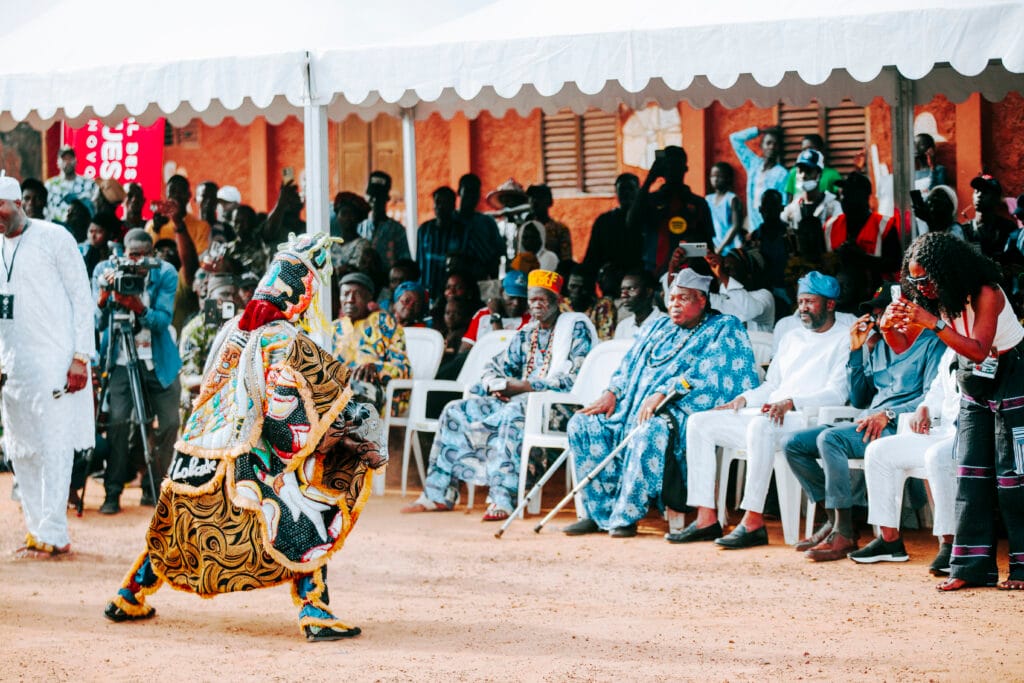
An Egungun ensemble — the stacked panels of cloth, the masking layers, the woven elements that obscure every centimetre of the human body underneath — is built and rebuilt over generations. Each lineage has its specific ensembles, and each ensemble accumulates additions over time: a square of cloth added when a new ancestor is recognised, a panel restored when an old one frays. The ensembles are heavy — some weigh more than thirty kilograms. They are also, materially, the lineage's archive. To see an Egungun in procession is to see a textile that has been worked on for two centuries.
The masquer — the human being who carries the ensemble — is selected, trained, and consecrated within the Egungun society. The selection is not casual. The masquer must be of the lineage, must be physically capable of bearing the ensemble across the long procession hours, and must have completed the preparation that makes him capable of carrying the ancestor without harm to himself or to others. There are years of preparation behind each appearance.
In the moment of appearance, the masquer is not the masquer. He is the ancestor. The voice that speaks is the ancestor's voice (in a deep, modified register that is part of the trained practice). The movements are the ancestor's movements. Members of the lineage who address the Egungun address the ancestor, not the man inside.
"The Yoruba do not say the masquer represents the ancestor. They say the ancestor has come. The grammatical structure is the cosmology."
What you will see at the Porto-Novo Mask Festival
At the festival, the Egungun appearances are typically the emotional centre of the two festival days. The major appearance is a long procession on the first evening, around dusk, when the Egungun societies of Porto-Novo's central concessions emerge into Place Jean Bayol. The drumming changes register; the crowd, even visitors who have arrived without context, becomes quieter; the masquers' movements have a slow, deliberate quality that is different from the festive dance registers of Gunuko or even from the dance of Guèlèdè.
On the second day, smaller individual Egungun visitations occur — specific ancestors of specific lineages visit specific concessions. These are less public and harder to access without coordination; they are the moments where, as a visitor, the editorial protocol matters most.
A specific safety note: do not approach an Egungun in procession. The Egungun societies have stewards — usually visible by their distinctive cloth — whose job is to keep a perimeter. The reason is not theatrical. The ancestor's presence is, in the tradition, dangerous to those not prepared. Crossing the path of an Egungun, touching the ensemble, or photographing in close range without authorisation can produce reactions from the stewards that are entirely warranted. The festival is public, but the public has positions; visitors stand where the stewards indicate.
Reading without belief
A common visitor question is whether one needs to believe what the tradition says — that the masked figure is the ancestor returned — in order to witness Egungun respectfully. The answer, in our experience, is no. The tradition does not ask visitors to convert. It asks visitors to recognise that, for the community present, this is real. The community's belief is not interrupted by the visitor's scepticism; it is interrupted by the visitor's behaviour.
The disposition we recommend is what an anthropologist might call methodological respect — for the duration of the appearance, you treat what is happening as it is treated by those for whom it is happening. You do not interpret in real time. You do not ironise. You watch. You let yourself be in the company of a community in its own work. The interpretation, the comparative reading, the critique if you want one — these come later, on the page, in conversation, in your own thinking. They do not happen in the alley while an ancestor walks.
This disposition is, in our reading, the difference between cultural tourism and cultural witness. The first treats the practice as material for the visitor's consumption. The second treats the practice as the community's own work, which the visitor has been permitted to attend.
The camera question
Photography during Egungun appearances is, in the Festival des Masques context, permitted under specific conditions. The ensembles themselves can be photographed during public procession. The faces of the masquers — the human beings underneath — cannot. This distinction matters because, in some moments of the practice, the ensemble is briefly lifted or the masquer's identity is otherwise revealed; those moments are not for the camera. Photographing them collapses the cosmological frame the practice is sustaining: the ancestor's appearance ceases to be the appearance if the human face beneath it is fixed in an image.
The same logic applies to children of mask society families. The Egungun societies are hereditary; the children of masquers are often present at the festival, sometimes carrying ritual objects. They are not photography subjects. Family permission, mediated through our coordinator, is the threshold.
For drone photography: not without specific authorisation from Benin Tours, which takes six weeks to arrange. The Egungun societies have asked, in past editions, that drones be kept out of Place Jean Bayol during their appearances. We honour that.
After the festival
Travellers who have witnessed an Egungun appearance often describe — months later, after the visit has settled — a specific kind of memory. Not a photograph in the mind, but a presence. The deep modified voice, the slow movement of the ensemble through the crowd, the silence around it. The memory is harder to render in language than other festival memories. Some visitors return; many don't. Both responses are honoured.
What changes, for the visitor who has read the Egungun in this way, is the understanding that the Yoruba-Nago religious world is not a museum object. It is a living institution that, at this specific square in Porto-Novo each July, makes itself briefly visible to those who have come with the right disposition. The festival is the opening. Whether you accept the opening — that is your work, not ours.
Continue reading
This article is part of our topic cluster around the Porto-Novo Mask Festival cornerstone. Related Field Notes : Guèlèdè at UNESCO — what the 2008 inscription said and didn\'t say · Zangbeto at dusk — a photographer\'s notebook.
Sources and further reading : Pierre Verger, Notes sur le culte des Orisha et Vodun (IFAN, 1957) ; Henry John Drewal and Margaret Thompson Drewal, Gelede : Art and Female Power among the Yoruba (Indiana University Press, 1990) ; the UNESCO file on the Oral Heritage of Guèlèdè (2008) ; conversations with mask society representatives in Porto-Novo, 2024 and 2025 editions.