
Travelling for the festival? Nine days in Benin, 2–10 January 2027, the whole festival week, from USD 2,905 per person with hotel and all meals, ten travellers at most, nothing to pay before we meet — see what it costs.
Voodoo Festival Benin 2027Vodun Days at Ouidah, 2–9 January: dates, programme, how to attend
Walk the routes.Meet the religion where it lives.
VIP seat at the great ceremony · Sahouè-Doutou · every lunch and dinner · pirogues and transfers. Hotels booked for you at cost, or left to you. See the full price table ↓
Updated October 2026
Voodoo Festival Benin 2027: the dates and the essentials
Vodun Days, the Ouidah voodoo festival as most visitors call it, is the official festival of the Beninese state in recognition of Vodun. If you are new to the religion, start with what Vodun actually is. It takes place every year at Ouidah over eight days — 2 to 9 January in 2027 — and it is one of the largest religious-civic events of the West African coast. Practitioners, descendants of the diaspora, scholars, journalists, and the Beninese institutional apparatus converge for eight days that braid the Vodun ritual calendar with public commemoration, political symbolism, and contemporary cultural patrimony.
Heritage and Routes takes you through Vodun Days as it should be seen: with someone who knows which square is playing at which hour, who is known to the priests, and who stands beside you when the masks pass. One traveller or ten, never more, and someone who knows the squares from the first morning to the airport. The eight days can also open a longer route: see our journeys in Benin, from the port of Ouidah to the royal palaces of Abomey. The journeys we run around the coming edition, and what they cost, are set out below.
Your guide is Fèmi Kochoni, founder of Heritage and Routes, a graduate in African and Diaspora Studies of the Université d'Abomey-Calavi, and for years Tour Director for Odysseys Unlimited and Grand Circle across Ghana, Togo and Benin. He lives in Cotonou; he does not visit the coast, he belongs to it.
Benin's voodoo festival is not a carnival. It is a festival of the state, of the religion, and of the diaspora — in that order.
We accompany the festival within the framework that Benin Tours, the Ministry of Tourism, Culture and Arts, and the Vodun community of Ouidah have built since 1996. Our programmes coordinate ceremonial access with the practitioners, never around them.
A state-recognised festival, since 1996
Vodun Days was instituted by the Beninese state in 1996, the year Benin granted Vodun legal recognition as a religion and made 10 January a public holiday. The recognition was both political and cultural: it formalised an institutional relationship between the state and Benin Tours, and it positioned Vodun as a cultural patrimony available for civic celebration alongside its religious life.
The festival has grown across three decades. What began in 1996 as a single public holiday on 10 January became, in recent editions, three days around that date, and in 2027 it is a full week ending on 9 January: 2 to 9 January — and it drew some 740,000 participants in 2026, up from 435,000 the year before — Beninese citizens, diaspora pilgrims arriving from Brazil, Haiti, Cuba and the African diaspora communities in the United States and Europe, journalists, photographers, academics, government officials, and the corps of foreign ambassadors based in Cotonou. The town of Ouidah transforms entirely for the duration of the festival. Hotels book a year in advance.
What it is not
Vodun Days is not a folkloric spectacle. The ceremonies are real ritual moments led by initiated practitioners under Benin Tours coordination. Photography is permitted in some moments and restricted in others — the practitioners decide. The festival is a window onto a living religion, not a performance for visitors.
How the eight days are structured
Vodun Days 2027 runs for eight days, from 2 to 9 January, in Ouidah. The 1996 decree fixed 10 January as a single public holiday for the traditional religions. In recent editions the festival ran for three days around that date; in 2027 it becomes a full week, from 2 to 9 January, ending on the 9th rather than the 10th. Eight days is the format of the 2027 edition, and the only figure that describes it.
The week has a shape, and it matters for your dates. The opening days belong to the civic register and to the ceremonies each lineage holds on its own square. The festival is at its strongest at the end: Friday 8 January on the squares, and Saturday 9, when the closing takes place at the Ouidah Arena in the afternoon and the great ecumenical ceremony gathers the lineages on the beach at night. The public holiday of the traditional religions now falls on the second Friday of January, Friday 8 January in 2027, with Thursday 7 also a holiday. If you can only give it a few days, give it the 7th, the 8th and the 9th: they are the heart of the ceremonies.
The detailed programme — which ceremony falls on which day, at which site — is set each year by the Ministry of Tourism, Culture and Arts in coordination with Benin Tours and the lineages, and it is released close to the festival. We publish it here as soon as it is available. What follows is the ritual geography that holds from year to year, not a schedule.
Inauguration, conferences, panels
The civic register opens the festival: the official inauguration at the Place des Vodun in Ouidah, academic conferences hosted by the Ministry of Tourism, Culture and Arts, and panel discussions with Benin Tours representatives, scholars from the Université d’Abomey-Calavi, and visiting researchers.
This is where we set the editorial frame — briefings with our academic partners, and the first conversations with the practitioners who accompany us through the festival.
The Great Vodun Ceremony
The central ceremonial register unfolds across multiple sites in Ouidah, with different Vodun lineages presenting at different locations. Place Maro hosts the Egungun masqueraders. The Esplanade of the French Fort hosts the Zangbéto night guardians. Place Ninsouxwé hosts the Zomadonou. The Sacred Forest of Kpassè hosts the Hounvè inner ceremonies.
Our programmes coordinate access for the public moments and, where the priesthoods permit, for restricted moments. Photography policy is briefed in advance and re-confirmed in real time at each site.
The Door of No Return
The closing register moves toward the Atlantic: ceremonies at the Mami-Beach Temple, the formal closing at the Ouidah Arena on Saturday 9 January, then the final movement to the Door of No Return beach, where libations, prayer and the closing rites face the ocean.
For diaspora pilgrims, the beach at the Door of No Return is often the most charged moment of the whole festival — the geography of return and the geography of departure, on the same sand.
Updated September 2026. The 2026 edition drew some 740,000 participants over the week, seventy per cent more than 2025, inaugurated the new Ouidah Arena on the beach, and put Kassav', Sagbohan Danialou, Toofan and the Balé Folclórico da Bahia on the seafront stage. The organisers' press pack for 2026 is public; the 2027 programme is published in December on vodundays.bj, and we relay it as soon as it is out.
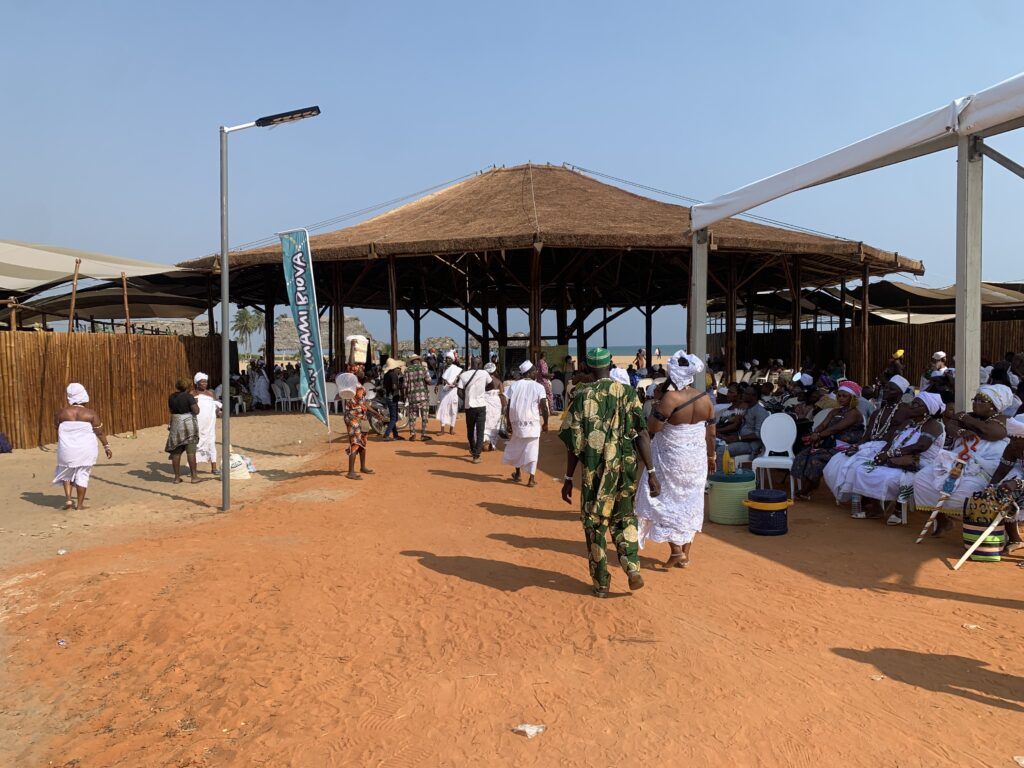
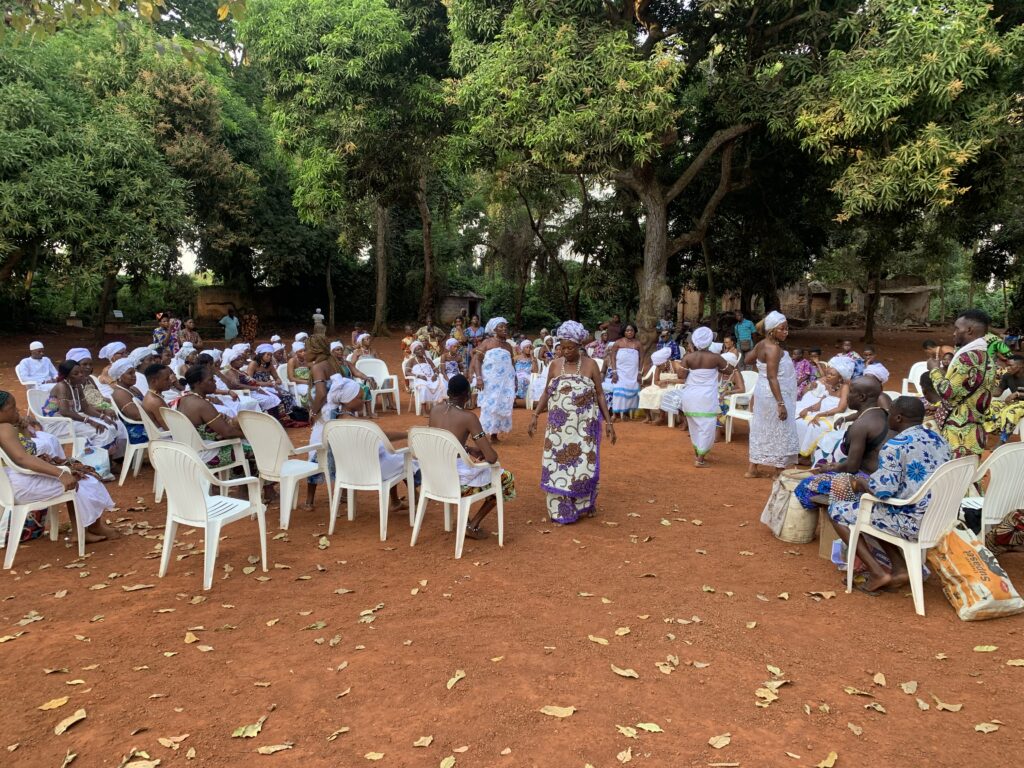
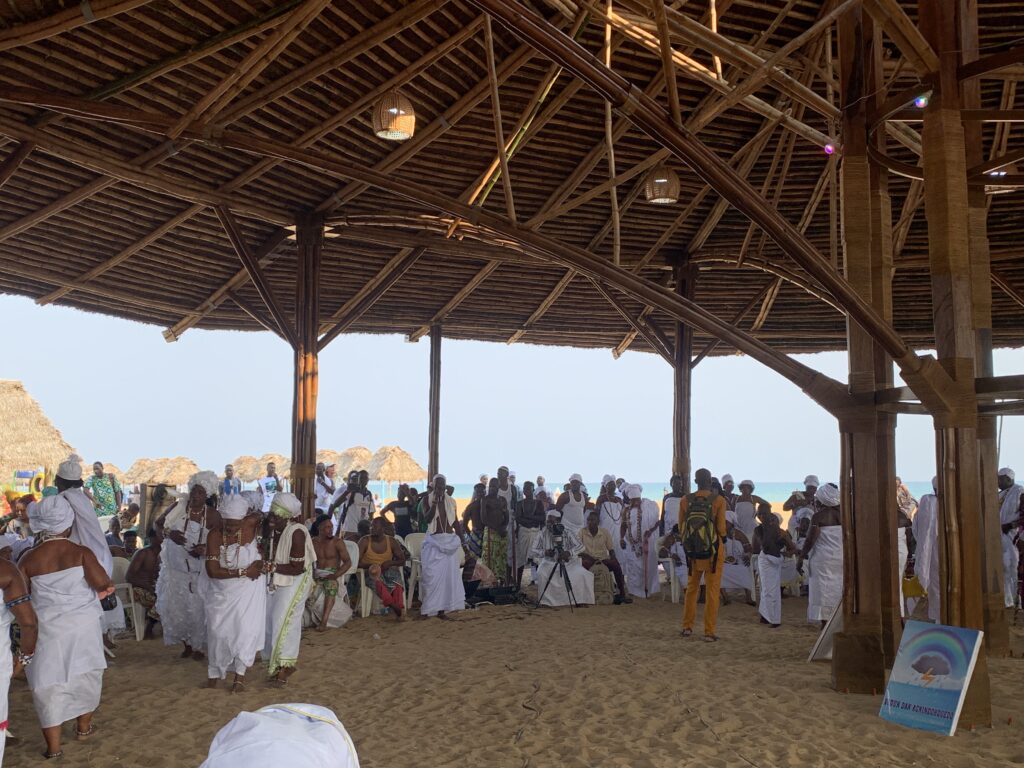
Photographs Heritage and Routes, Ouidah, January 2026.